Monday, October 01, 2007

Bayshore Town Center: Still a Place for Cars

Having made a few trips up there, I figure it's time to throw out my two bits' worth on Bay Shore Town Center.

Bayshore Town Center

Let me start by saying that, whatever gripes I and others may have, they've really achieved something remarkable here. It's a brand new Main Street, something we haven't built in America in five decades. It does a lot of things right: streetside parking, sidewalks, lots of visual and functional connections between inside and outside, public spaces, mixed uses, a welcoming and inviting atmosphere. There may have been some tactical and strategic blunders along the way, but the people who built this thing were striving to make something a cut above the usual suburban drek of our times, and I really appreciate that.

Bayshore Town Center

That said, I have some gripes. Some are easily fixed. Others... well, like I said, this sort of thing hasn't been done for fifty years, so maybe it's inevitable that it'll take a few tries to work out the kinks.

Make no mistake about this place: pedestrian-oriented or not, parking is still king. Parking lots, curbside parking, parking garages, and more parking lots surround and suffuse the place. There is an assumption in place that 100% of customers will arrive by automobile. You can see it in any number of ways.

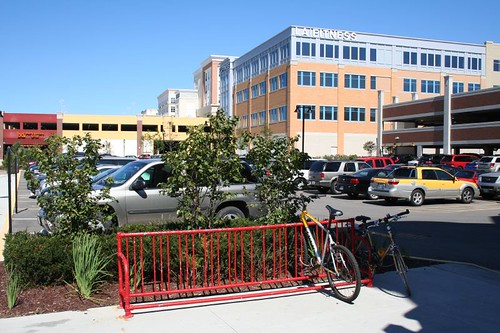
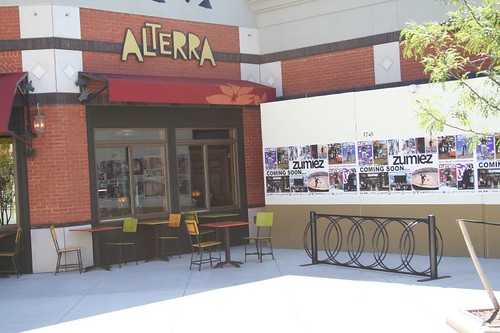
For example: where the hell are the bike racks?! I surveyed the entire complex and, after much searching, located a grand total of three bike racks in the entire place. One's next to Alterra Coffee, one's kind of tucked off to the side by the central plaza, and one is a battered relic outside the entrance to Trader Joe's, which itself is rather detached from the pedestrian action to the east. Only this last one seems to be placed with the idea that customers using a store might arrive by bicycle.
Bayshore Town Center

Bayshore Town Center

The sidewalks ought to be lined with small M-racks, or the loops that simply bolt onto parking meters. Every major store ought to have a longer set of M-racks. Kohl's certainly has the room for it:

Bayshore Town Center

In a complex that's overflowing with parking, the lack of consideration for bicyclists is appalling. This problem could be fixed with relative ease.

For a "town center" based around a Main Street concept, the complex is a bit disconnected from the actual main commercial artery of Whitefish Bay, Silver Spring Drive. To get from Silver Spring to the heart of BSTC requires navigating a winding road past a minefield of parking lot and garage entrances. It's intimidating on a bike and not much fun in a car.
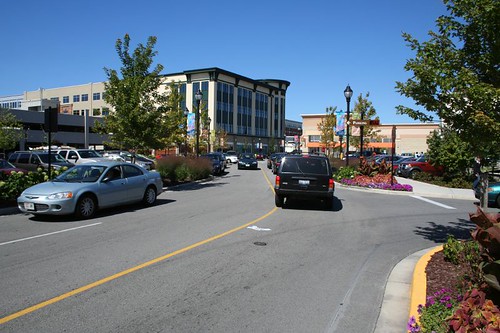
Bayshore Town Center

Winding roads, in fact, seem to be commonplace. It's largely an artifact of working around randomly placed existing buildings. Whatever the cause, it slows traffic down to a pedestrian pace (in such intimate quarters, that's a good thing), and it gives the commercial portions of the complex a bit of charm they might otherwise lack. To claim the place is without any sense of the past is not really accurate -- the whole thing is very much shaped by the existing mall buildings that have gone up over the past few decades.

Bayshore Town Center

On the east side, Bayshore Town Center remains as oblivious as ever to its residential neighbors, facing them with vast parking lots and the backsides of the mall's older buildings. The new exit to the east doesn't even align with the street across from it.
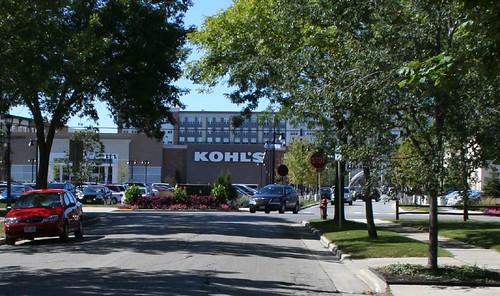
Bayshore Town Center

Probably the intention was to have the new street on axis with the central plaza, but a more respectful approach to the existing street grid would have been to align the road with the older street, then curve it as required to bring it onto the desired axis. At the outer edge of the complex, nobody is going to be awe-struck by the axial view past a hundred yards of parking lots.

Bayshore Town Center

On the west side, the Center pays proper homage to the nearby roaring interstate -- by turning its back to it, showing little besides parking lots and garages. This is the proper place to load up the sea of parking -- not where the mall abutts an older suburban neighborhood.

Bayshore Town Center

As others have mentioned, the architecture is largely forgettable -- a mishmash of contemporary commercial (acceptable, not especially interesting) and historical pastiche (corny, depressing), with the sole exception of a snazzy Modernist steakhouse, clad with a stunning contrast of polished flat-cut black stone panels, and random ashlar stone.

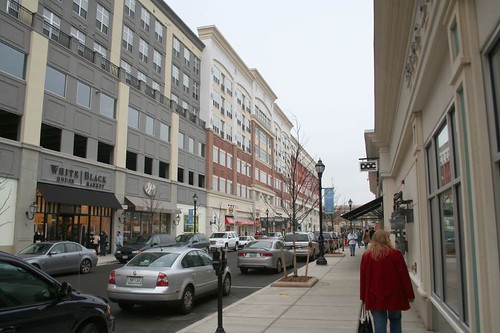
Bayshore Town Center

Bayshore Town Center

It's not as though the same red brick and EFIS that clad most of the buildings couldn't have been used to more memorable effect. It could have. But the designers or the owners wanted something that would conjure up vague images of an ambiguous historical past, and weren't willing to pay the considerable amounts of money it would take to do it right. That's the thing about contemporary architecture: it's good design adapted to today's building technologies. Do it right and it can be (relatively) affordable and good looking! Try and reproduce.... whatever it is they're trying to reproduce here without using the real materials, the real techniques, the real craftsmanship that went into the original, and you're going to end up with buildings that look like soggy cardboard.
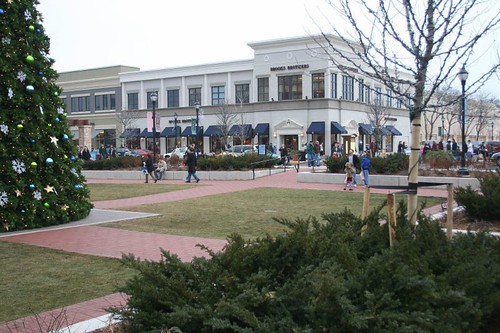
Bayshore Town Center

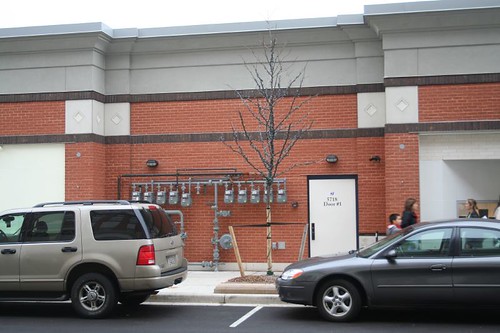
And finally, at times it seems the architects didn't quite leave themselves enough room for all the ugly necessities:
Bayshore Town Center

There's also a lack of benches or other places to simply linger, outside of the central plaza.

So. There's lessons for next time. Meanwhile, the revived Bayshore seems to be doing a good business. You go there and you'll find people wandering the sidewalks, mingling, travelling on foot, even if only for a little while. Given that this is the closet thing we've had to urban expansion in the northern 'burbs, it's hard to find fault with that.

Friday, September 28, 2007

An Unfortunate Decision for the Goldmann's Building

Goldmann's Last Day

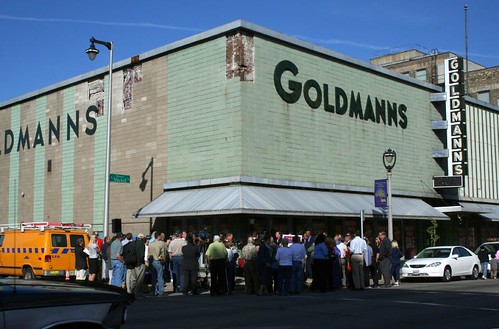
Today was the final day of business for Goldmann's Department Store. Though the store was virtually empty of goods and wares, the lunch counter was packed throughout the day. At mid-afternoon, a crowd gathered to hear words from Mayor Barrett, the store's current and future owners, and neighborhood representatives.

Closing Ceremonies

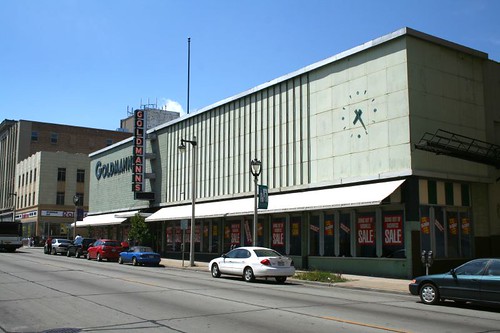
Among the words of bittersweet reminisce and optimism that the building will continue as a place of commerce and communal gathering was a statement regarding its architectural future. The building will be remodeled inside and out, with the exterior being returned to its 1920s appearance.

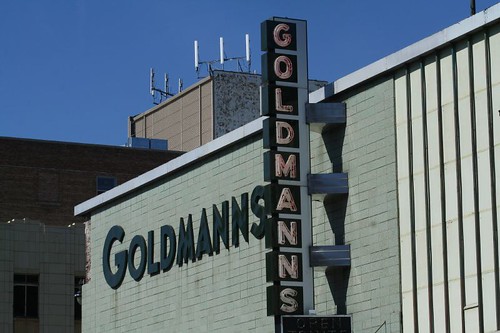
Goldmann's Department Store

Goldmann's Department Store

I think it's a big, big mistake to do this.

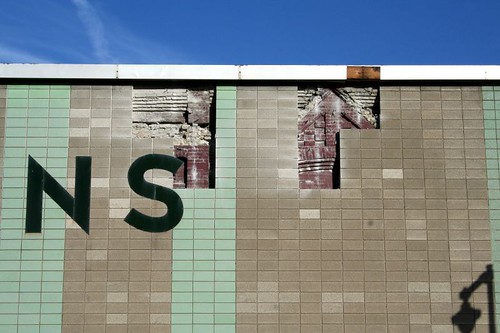
Exploratory work has been done on the west elevation, removing some of the CMU coverup facade to see what remains of the older building beneath. From what I can gather, it looks like there might actually be two older facades underneath the 1950s coverup, one on the west side dating from the building's original construction (a strongly Victorian composition in red brick) and a circa 1920s reworking on the Mitchell Street side in brown brick. From the looks of what's been exposed, none of what remains is in particularly great shape, and a lot is missing. It can certainly be repaired, but it's going to be a lot of work.

Testing the waters

But the end result will be undistinguished. Not that the building itself will necessarily look bad, but it will simply be more of what we already have lots of in Milwaukee. Brick Victorian commercial buildings are a dime a dozen in this town. Heck, there's a brown brick Chicago School building right next door.

The kind of bold, slightly campy yet unabashedly Modernist facade that has adorned Goldmann's for the last fifty years, however, is a vanishing rarity in Milwaukee. When this facade is wrecked, there won't be another one like it in the city. It is a unique creation, and its demolition is no less an architectural tragedy than the demolition of 19th century buildings is.

Goldmann's Last Day

You want historical value? Nobody born after 1945 is likely to even remember the way the store used to look. For most Milwaukeeans, Goldmann's current appearance is simply how the store has always been.

Does it fit with its surroundings? Well, exactly which surroundings are we talking about? The Beaux Arts detailed Schuster's building? The Deco building next to that? The wood-framed gabled buildings with Flemish curved facades? Maybe the 1960s Modern bank across the street? Mitchell Street is a riot of architectural styles, both high and low, each one contributing to the street's visual vitality. Removing its premier 1950s entry will not enliven it, but make it more bland.

Goldmann's Last Day

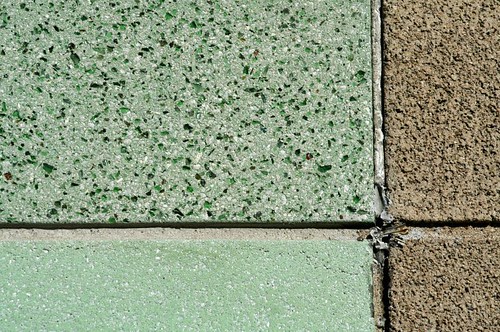
Is the facade bland and boring? Not at all. A close look rewards the viewer: the facade uses several different kinds of CMU, two of them tinted, one with ground glass embedded in it. Metal panels cover another portion of the facade, with a minimalist clock (sadly nonfunctional) at one end. A marching row of metal rods sits in front of this portion, offering an endless play of shadows as the sun moves across the facade. Details include the clock, the shiny aluminum and neon sign, and the bold lettering on the western facade.

Goldmann's Last Day

People gathered today to lament the loss of an institution. Yet the loss of its physical embodiment was treated as cause for celebration. I'll say it again: in twenty years, people are going look at the heritage of the 1950s, and wonder why the heck we didn't save any of this stuff.

Book Bargain

The Heritage Guidebook by H. Russell Zimmermann is on sale at Harry W. Schwartz Bookshops for $5. It's a thorough guide to "landmarks and historical sites in southeastern Wisconsin", with entries on hundreds of buildings in Milwaukee and the towns surrounding it. It's well worth picking up, especially at that price!

Thursday, September 27, 2007

UWM Needs New Bike Racks

For all the effort that UWM puts into encouraging its students not to drive to the crowded campus...they sure don't seem very committed to encouraging bicycle use.

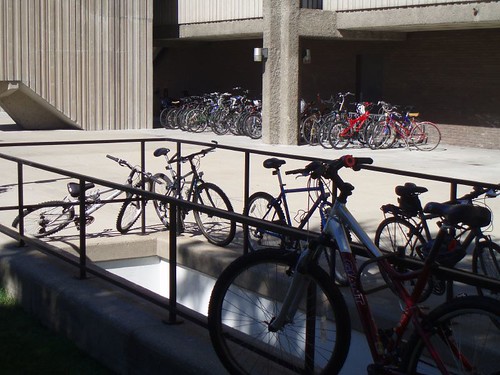
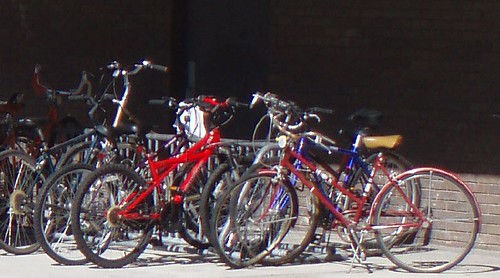
Take a look at the bike racks at the Union, mid-day on a Wednesday:

A mob of bikes

They're jam packed. All three racks are full, and more bikes are locked to the guard rails around a nearby stairwell.

But look at the racks. They're the old-fashioned gridiron type. This type of bike rack is meant to have the bike's front wheel lifted over it. This requires a considerable ffort on the part of the users, especially if the racks are crowded. (If??

UWM bike rack

But many bikes today (such as my own hybrid) can't fit over these racks. Users then have no choice but to lock nothing but the front wheel -- an open invitation for the rest of the bicycle to be stolen.

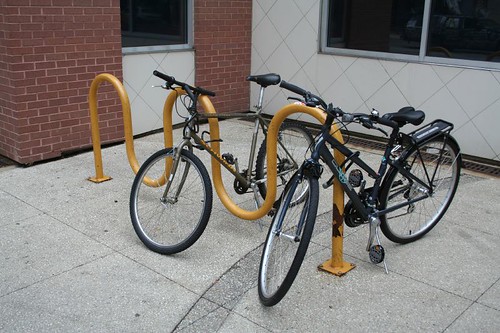
Bike racks at the Grand Avenue Mall

Modern racks are a W shape, like these outside the Grand Avenue Mall downtown. They allow bikes to roll in without lifting and allow all types of bikes to be locked by the frame, not just the front wheel. They are permanently installed, rather than being a loose rack that gets shoved around when empty. And they are far more attractive.

UWM should be installing these, rather than letting this clear need go so inadequately met.

Wednesday, September 26, 2007

Doomed Mid-Century Modern

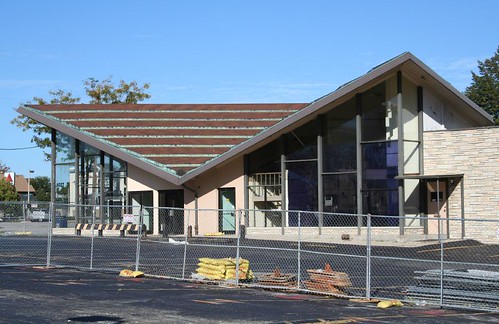
Surely Doomed

This little bat-winged building stands in West Allis, on Greenfield at 61st Street. It faces a simpler building across a parking lot. Both are fenced off; the second building appears to have undergone abatement (removal of asbestos and other hazardous materials.) Abatement's the harbinger of either renovation or demolition. Given the vintage, I'm betting on the latter.

It's a shame. The bat-wing building is particularly nice, with two clusters of multi-height hanging lamps at the apex of its pyramidal roofs, overhangs lined with downward-aiming can lights, and a stepped roof unlike anything I've ever seen. Like the similarly-conceived Mark Twain Cinema in St. Louis, I'm sure it looked impressive when lit up at night.

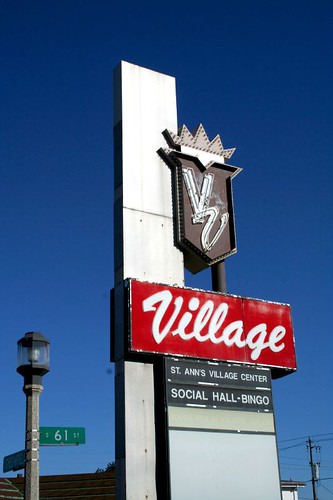
Surely Doomed

The sign -- another interesting period piece -- announces it as the St. Ann's Village Center, offering bingo, but the VV logo points to a previous name along the lines of Value Village. The second building was most recently a sales center for bathtubs and whirlpools.

And so another bit of our Mid-Century heritage passes away. In twenty years, they're gonna wonder why we didn't save any of this stuff.

Sunday, September 16, 2007

Walgreens revisited

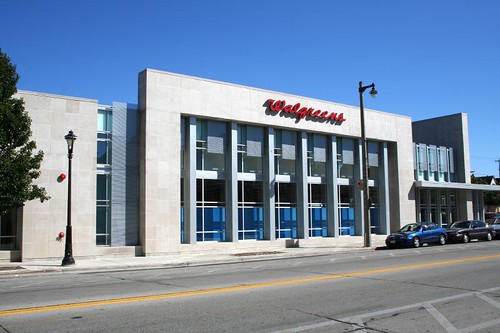
Massive, bold, strong

A recent Journal-Sentinel column praised the design of the new East Side Walgreens on Oakland Avenue. I agree, as a building, it's pretty sweet -- it's a set of bold forms, with some nice accent detailing (it's forbidden in these Modern days to call it "ornament" even though that's exactly what it is, but that's a subject for another post.) It's pleasing to look at, and a big, big step up from a typical suburban outlot Walgreens.

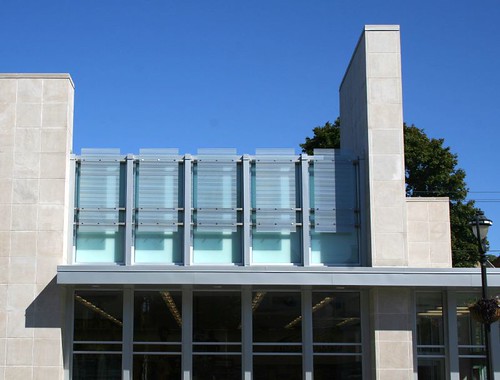
It's ornament!!

But it's still a Walgreens. It still means we lost our neighborhood grocery store, the only one within easy walking distance for thousands of UWM students and neighborhood residents. It still replaced a functionally identical Walgreens just a block south.

But I've griped about that before. It was a business transaction, among consenting private entities; the fact that it screwed the entire neighborhood.... well, that's just tough luck for us, right? Free market and all that. Me, I've been doing my best to avoid the Oakland Walgreens since last summer, when they killed off our Sentry.
For the present, here are a few other notes:

- The bike racks, which I had understood to be respectfully placed within the brick wall recesses along the sidewalk, are in fact located nearly at the back of the lot, on a sidewalk alongside the store -- a clear statement that they were an afterthought, not a priority. Similar non-consideration was given to the propane tank storage, a crude metal cage plopped on the sidewalk (and closer to the entrance than the bike racks.)
You need binoculars to see the other end.

- I can scarcely fathom how enormous the parking lot is, especially for its highly urban location. I wonder if it will ever be anywhere close to full. I wonder if Walgreens has any statistics on how many of their customers arrive on foot or by bicycle. But hey boy, lookit that there green space!! That's what Oakland & Locust really needed -- not more businesses, not apartments, but some fantastic green space. After all, it's an arduous five hundred foot walk to the nearest major urban park.

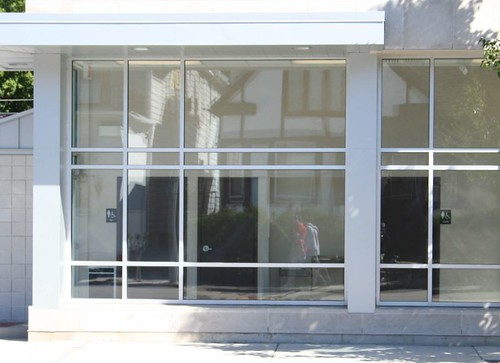
- Someone was clearly hammering a square peg into a round hole. The Oakland Street elevation consists of massive glass windows, which open up the store's interior and allow passersby on the sidewalk an inviting view of....

Loo with a view

...the doors to the bathrooms?!

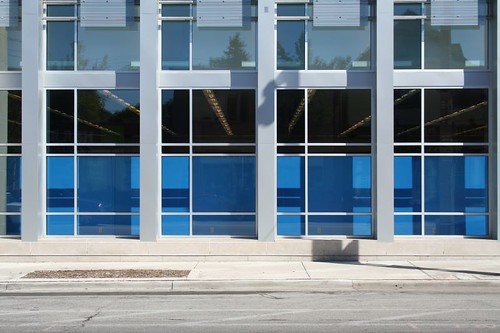
And where are the window displays, which, y'know, are ostensibly the point of having display windows? Windows can also serve to open up the space to the outside, and to bring natural light, but those seem to be verboten under retail rules of conduct, and indeed if you removed the blue panels you'd find yourself looking at the backside of a display shelf.

Display windows, missing just one little thing...

- There are several nice benches and half-walls to provide space for people to sit while waiting for a bus or whatever else. It's a thoughtful gesture.

- I've heard many people over the years complain about Modernist design, and a couple in regards to this particular building. I perosnally find an unambiguous beauty in this sort of bold massing contrasted with delicate, transparent ornament.

Saturday, September 15, 2007

It may be chilly, but it looks nice!

It's been a beautiful week in Milwaukee! Clear skies and crisp air have drawn me outside with my camera every evening this week, and I've come back with a crop of great photos.

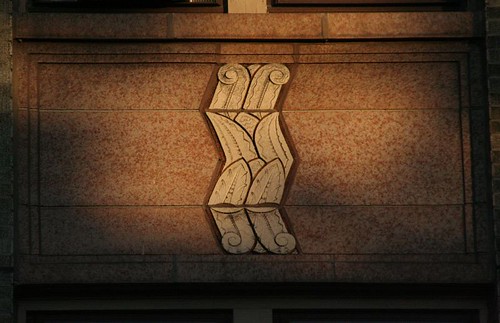
Milwaukee Deco

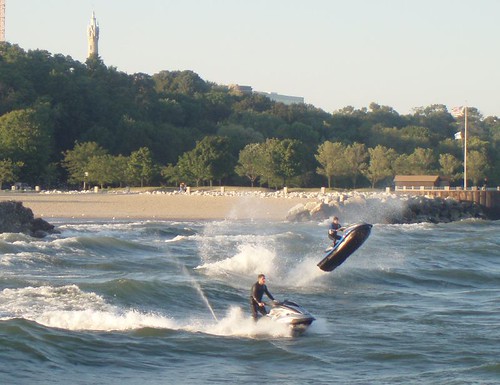
Jet skiing

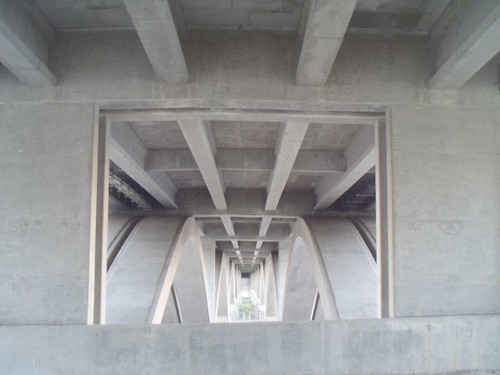
My only friend

Many more can be seen here.

Thursday, September 13, 2007

Two urban articles, and a note

Two interesting and topically related articles in the Shepherd this week:

Urban Living, Sprawl and Transit: an interview with former mayor John Norquist.

On the Road to Sprawlville, Shop 'Til You Drop: a look at the shady politics supporting the exurban Pabst Farms development.

- - -

The FlexCar system has debuted at UWM! This fantastic idea lets you essentially rent a car on an hourly basis -- allowing you to bypass the expense and difficulty of car ownership without suffering the negative side effects.

- - -

On a personal note, I will be moving to Chicago at the end of this month, in pursuit of both professional and personal goals. This blog will remain in place, for the foreseeable future at least. Given the mental backlog of topics I still want to write about, I could keep going for quite some time!

Thursday, August 30, 2007

Amtrak vs. My Bike

Following, an email I just sent to Amtrak's customer feedback:


Ahhh, another weekend, another trip between Milwaukee and Chicago.... which I won't be making on Amtrak.

Why? Simple: I can't take my bike.

Sure, I could put it in a box. I could also saw off my arm and put that in a box, too. It'd be only slightly less practical, and not nearly as painful.

I tried the bike-in-a-box thing once recently. A friend and I struggled for nearly 45 minutes to disassemble the bike and awkwardly cram it into the bike box, then jam it with some difficulty into the car (it didn't really fit).

Essentially, we took this incredibly efficient, sleek, compact, lightweight form of personal transporation, and turned it into an unweildy, awkward, enormous piece of oversized and immovable luggage.

We finally got to the station only to find they wouldn't let me on the train with it; I had to check it in as luggage. Luggage!! They wouldn't even let me just walk onto the (half-empty) train with it. It was maddening!! I nearly screamed in frustration, and almost missed my train as a result -- my friend had to come back to the station and take the box away before I could board.

You guys NEED TO CHANGE THIS POLICY. It's a bad policy. It's dumb. It costs you business. It discourages people like me -- those who rely on a bicycle for transportation -- from riding your trains.

There's no excuse for it. You've got the room. Spend a few bucks, take out a couple of seats on each train, or make them fold-aways, and poof -- room for 3-4 bikes. Have the rider carry the bike up themselves, require them to bungee cord them down. Make them wait till most passengers have boarded if need be; don't allow them on rush hour trains if you have to. Very simple. This works for New Jersey Transit. It works for Philadelphia's regional rail. It works for Chicago's Metra system. You're telling me it can't work for Amtrak? All those little dinky local rail systems can manage something that Amtrak can't?

When is this going to change, huh?

With that incentive, I'd gladly shell out the $21 for a ride to Chicago on a weekly basis. Without it, my money goes to Megabus, and Amtrak gets nothing but my ire.


For the uninitiated, Amtrak will only allow bikes on their Milwaukee-Chicago trains if the bike has been put in a taped-shut box and checked in as luggage. They might as well just tell us to take our bikes and stick 'em. It's a measure that's utterly impractical.

I'd love to have my bike down in Chicago on the weekends, and I hate having to lock it up at the train station, but thanks to Amtrak's absurd policy, there's not much other choice.

Wednesday, August 29, 2007

Newly carless

Two weeks ago, I sold my car. It had been legally out of commission since failing emissions at the end of July, and I stopped driving it after that. I have not replaced it yet, and don't have any immediate plans to do so.
This makes me one of five housemates, all adults, all licensed drivers, none of whom own a car. Yet this was not a decision based on urban or environmental idealism. I was just sick of spending money on the thing. It needed work immediately, probably a thousand bucks' worth or more. I didn't use it much in my day-to-day life -- mostly as a convenient way to get to work on rainy days, and occasionally to port the groceries home. I don't really need it for work, at least for the foreseeable future. And the bulk of my social life is centered around the East Side, where everything's in easy walking or biking distance.

The value I got from it was simply not equalling the value I was having to put into it. For the moment, the equation holds up for getting a replacement car, too. That may change when winter rolls around, but we'll see.
For now, my short-term debt has instantly evaporated thanks to the money from selling it and the refund on my insurance; I no longer have to budget out hundreds of dollars for endless maintenance and repairs; and I no longer care about every little noise from the alley that used to be somebody potentially breaking into it while it was parked.

Do I miss the mobility? Sure. Most of all I regret the inability to convey other people. When a friend needed a ride from the train station, I was only able to help because one of my housemates happened to have a borrowed car available.

I've made a few adjustments to my routines, such as more frequent stops at the grocery store on the way home from work. I more willingly spend money on things like bike repairs or cab fare -- they're a lot cheaper than the endless whammies of gas, insurance, repairs, maintenance, and registration. I have to limit how I pack for my weekly trips down to Chicago. I've learned how to bungee cord a lot of oddly-shaped items to my carry rack.

I may replace the car come winter, if the need arises; I would definately miss being able to zip around the city with my camera, which gets tough on bike after November or so. Still, with Zipcar coming to the East Side, I just might be able to get along without a car of my own.

Friday, August 10, 2007

Looking back 4 decades

From the Journal-Sentinel last week: Flash Point: Racial tension in the summer of 1967 fueled deadly violence, a fascinating snapshot of Milwaukee's social and emotional state 40 years ago, as violence and rioting engulfed portions of the inner city. It's part of a series reflecting on the 1967 riots.

Monday, August 06, 2007

Demolition everywhere you look

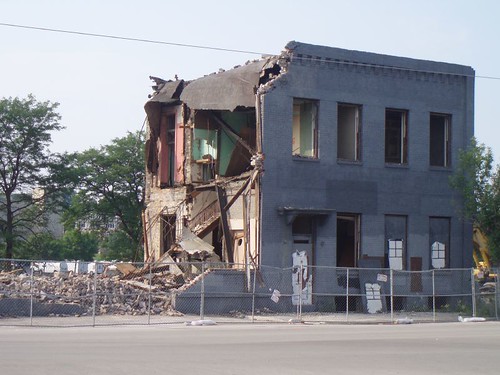
A lot of buildings are coming down at the moment...

Pabst Brewery

Pabst Brewery

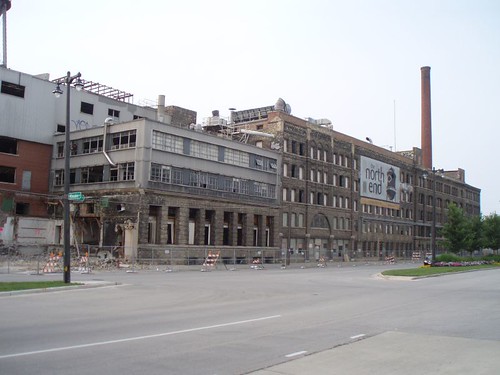
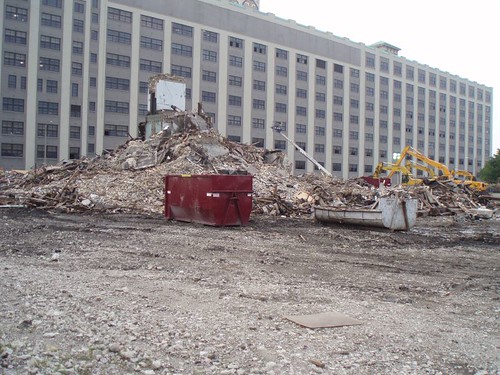
Demolition has been ongoing at the long-shuttered Pabst Brewery since around January; this is the second major building to come down, but many smaller structures have been removed as well. This one sported a beige smokestack with "PABST" in glazed white tile; its 1950s Modern window walls were a favorite subject of mine:

Pabst Brewery, Milwaukee


Not far away, serious work has kicked in on the old Pfister-Vogel Tannery:

Pfister-Vogel Tannery

Pfister-Vogel Tannery

Most of the one-story additions and small outbuildings have been taken down:

Pfister-Vogel Tannery - outbuilding being demolished


Remediation work has been underway on the facade of the main building, with environment suit-clad workers riding a cherry picker up to the windows along Water Street. It looks like the demolition will move west to east, which would leave the most important brick facades intact until the end. The strategy seems to be to take down the lower portions in the back, which should give the taller portions in front somewhere to fall, including the towering smokestack. I'm waiting to see if a crane shows up on site to salvage the enormous roof-top water tank.


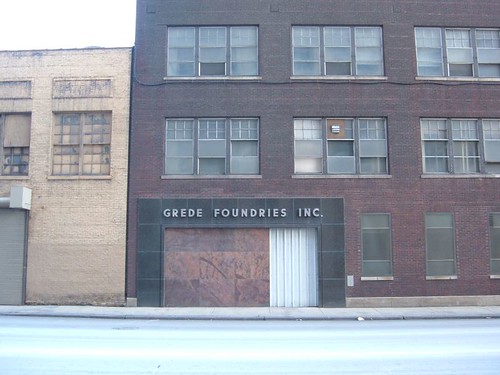
And finally, I was shocked on Friday afternoon to see that the last standing portion of the Grede Foundry was actually being knocked down:

Grede Foundry rubble

The office building has been standing, heavily frayed at the edges but essentially intact, for over a year now -- long enough that I'd almost convinced myself it was going to be saved. Why it was spared for so long is a mystery, but as of today it's entirely rubble.

Grede Foundry

I just hope someone salvaged those handsome raised aluminum letters; they were slick (especially on their polished stone background.) I'd been eyeing them myself for a long time!

Monday, July 23, 2007

Hold Your Nose

AUUUUUUUUGH

The pungent, potent, powerful aroma of Milwaukee beaches in the summertime has returned at last. The smell of rotting dead algae was wafting up the bluffs this afternoon and was still strong as far away as Downer Avenue.

It's so embarrassing. Can't something be done about this olfactory assault?

Tuesday, July 10, 2007

Goldmann's Department Store

As was heavily reported a month or two back, Milwaukee classic Goldmann's Department Store will be closing its doors in October, The independent department store has operated since 1896; in recent decades it has lost noticable business to big box stores and department store chains. Its owners, both in their late 70s, have chosen to retire and wish to close the store while it remains a profitable venture.

The store's interior has remained virtually unchanged since the 1950s, and even then it wasn't massively altered. The exterior was given a Modernist facade in the 1950s, including a handsome clock and a fabulous neon sign.

Goldmann's Department Store

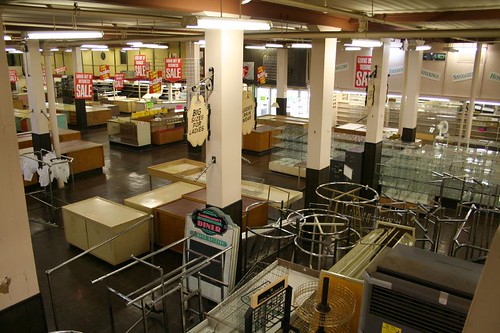
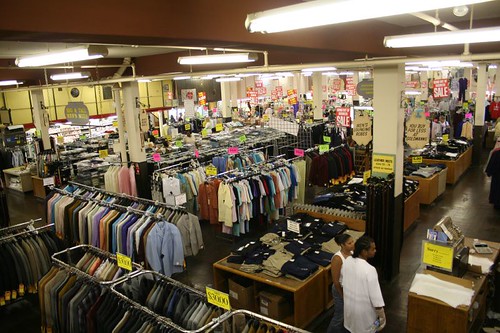
I was passing by this weekend, and stopped in for a lengthy look around. Normally department stores are loathe to have people roaming about with cameras -- but I wasn't the only one at Goldmann's. I explored every inch of the place -- basement, first floor, a mezzanine, and second floor -- and found it packed with oddities, relics, and delightfully mismatched odds and ends.

Goldmann's Department Store

Even with the 1950s interior renovations, the place retains much evidence of its Victorian origins. Exposed steel beams, an old staircase and modestly elaborate railing, and a prevalence of wood construction speak of a building much older than its facade.

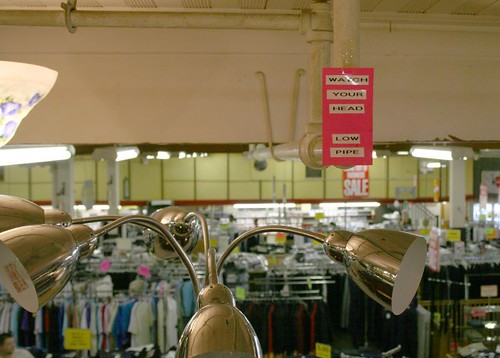
Low Pipe!

The building's plumbing and HVAC systems are a mishmash of haphazard accumulations, added piecemeal over the decades. Some of the pipes in the mezannine area are actually at forehead height -- a condition that would never pass muster with today's building codes. Cooling is provided by massive free-standing air conditioners the size of refrigerators, dating from the 1960s. Heat comes from radiators scattered randomly about, some right in the middle of the sales floor.

Goldmann's Department Store

It is these systems that more than anything doom the interior space as a whole -- they'll never pass code today. The building will surely be gutted by its new owner for renovations.


That sales floor is home to a vast array of merchandise -- clothing in a huge array of sizes, suits in a rainbow of colors. The men's department is presided over by a tailor in his 70s who has worked in the store for decades and has known it since childhood. Alterations and pressing are done in-house.

Goldmann's Department Store


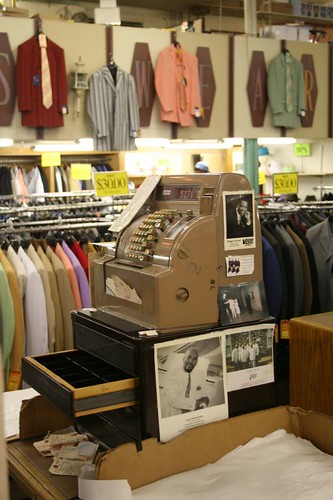
Cash registers throughout the building are vintage analogue machines, the kind that disappeared several decades ago from most other businesses:

Goldmann's Department Store


Long-dated "modernizing" touches are scattered here and there. They give the strong impression of being installed in the mid-1960s, when the New Formalism movement was at its peak -- particularly these faux concrete thin shell arches, complete with hanging globe lamps:

Goldmann's Department Store

The diamond backgrounds for the Men's Wear sign create a similar effect of intended Modern elegance, though they could also date from the Googie excesses of a decade earlier.

Goldmann's Department Store


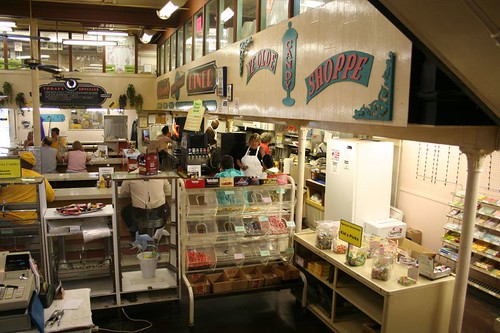
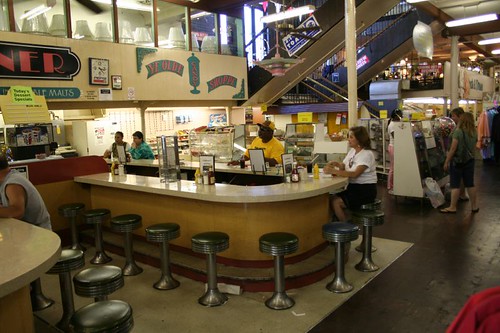
At the other end of the first floor, the lunch counter is a slice of 1950s diner streamline, against a backdrop of Victorian decorative touches. Three walk-in counters with curving ends offer seating to diners perched on fixed, round, green-cushioned stools.

Goldmann's Department Store


(Victorian? Yes -- note the floral column capitals:

Goldmann's Department Store


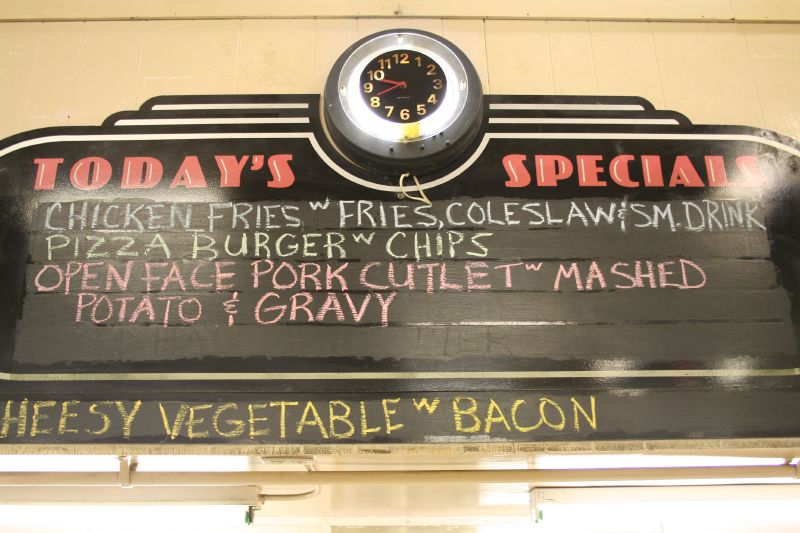
When it comes time for fixtures to be sold off, I'm sure someone will pay a hefty price for the slick daily specials sign and its integrated clock:

Goldmann's Department Store


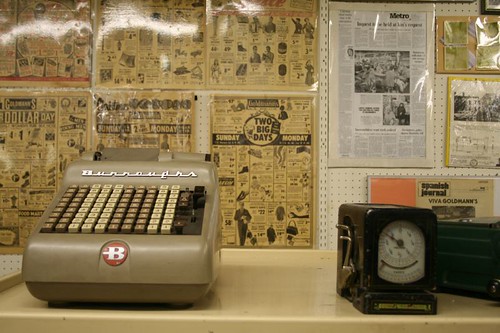
On the mezzanine level, in addition to a wide selection of lamps and shades, the store contains its own mini-museum of photographs, old newspaper ads, and antiquated calculting equipment:

Goldmann's Department Store


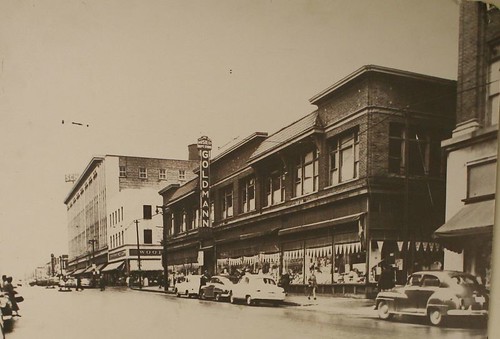
Of particular interest is a photo of the building prior to its modernization:

Goldmann's Department Store

(Personally, I find it more interesting with its current facade!)


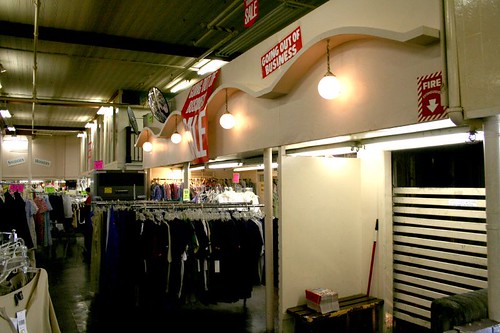
The store's Going Out of Business sale has begun. In the basement, a corner has already begun accumulating empty clothing racks, and spaces in the 2nd floor are emptying out as well. The time to go see this amazing retail time capsule is now -- it won't be the same for much longer, and very soon it will be gone forever.

Solvay Coke Plant

Sandwiched inbetween the rail lines east of Kinnickinnik and the Milwaukee and KK rivers is a long-abandoned industrial site, with the remains of a number of buildings crumbling away among weeds and broken concrete. A bit of online searching reveals that this is the remains of the Solvay Coke Plant, which operated on the site from around the turn of the century until 1983 when it was abandoned. The coke manufacturing process is intensely toxic and left the site a contaminated brownfield.

Solvay Coke ruins

Solvay Coke buildings

Several intrepid explorers have published photos of this fascinating complex of buildings, including an especially good one here. Most of the site has been demolished in the last couple of years, a massive blank slate awaiting cleanup and redevelopment.

Other pages:
Photos from when the plant was in operation.
Development plans, from the Journal-Sentinel.

Sunday, July 08, 2007

Summerfest Promenade

If you've ever been on a stroll down Philadelphia's glorious South Street, then you know what a true urban shopping street is -- a destination, a gathering point, a place where there's always a crowd. It draws the young and the old, the normal and the deviant, families and singles -- everybody. South Street pulses day and night, and people come there not just to visit its innumerable shops, bars, restaurants, and other businesses, but also just to hang out, to watch people, to disappear into the anonymous crowd. The desire for such communal interaction is a basic human need, and South Street fulfills it beautifully. One can observe the same thing at work on Chicago's Clark Street and Michigan Avenues, and Madison's State Street.

So. Where is Milwaukee's South Street?

Some would point to Brady Street, and I'll admit, it's come a long way -- even in the six-going-on-seven years that I've lived here. But even at its summer weekend night peak, Brady never really has a crowd. If you walk up the street, then back down, then back up, anyone paying attention will notice that you went by three times. There's not enough people there to get truly lost in, and while I won't say it's outside the realm of possibility, I don't see that kind of environment in Brady Street's future.

You could also point to the Water Street bar district, but it's a one-note show: an ordinary downtown street in the day, with the crowds only coming out on weekend nights -- and those crowds are functionally homogenous, basically people who are there to go to the bar. It also suffers from being on a major boulevard of a street. East North Avenue is another possibility; its business offerings are much more diverse, but hemmed in as it is by the river and the hospital, its growth is probably about maxed out. The crowds there on a Saturday night are, again, just not thick enough to cut it. The rest of the city's commercial and nightlife streets -- KK, Milwaukee, Farwell/Prosepct -- are all smaller still.

There's the lakefront, but it's mostly a daytime operation, and it's physically separated from the fabric of the city, and its crowds are too thinned by the sheer size of the place to provide urban anonymity.

We simply don't have a South Street here. And as a self-respecting city, we really should.

- - -

If you check the Shepherd-Express's yearly Best of Milwaukee poll, one of the votes that jumps out is "Best People Watching Spot: Summerfest." Summerfest?! Our best people-watching spot is only around for ten days a year!

So... could the Summerfest grounds become Milwaukee's own South Street?

What I'm thinking of is a pipe dream to be sure, but indulge me a moment.

The Meier Festival Grounds are a rather haphazard jumble of permanent stages and kiosks, with no clear sense of navigation or orientation. It was planned and built piecemeal, with nobody quite anticipating how enormous the whole production would eventually become. It's hard to find your way around when the place is jam packed with thousands of people. Sound bleeds between the stages, and you never know if you've missed some aspect of the festival or not. A master plan was finally developed back in 2000, but hasn't really been implemented in full.

If unlimited funds were to fall like manna from the heavens, I'd love to see much of the existing grounds torn down and redone with a clear, comprehensible master plan, oriented along a clearly defined, broad central circulation path. And in doing so, I'd love to see the vendor booths, special exhibits, and midway rides re-oriented to form one long strip of uninterrupted boardwalk-style bliss along the water's edge. Separate it from the stage areas, and they could keep it open all summer. Milwaukee's lakefront has beaches, a marina, lovely walkways, a wonderful pier, lots of trees and grass and even a lagoon... but where's our boardwalk? Summerfest should be it.

Like I said -- it's a pipe dream. I especially can't see it happening now that the new Lakeshore State Park is open just across the water -- can you imagine the howls of outrage if a semi-permanent carnival was announced a hundred feet from a prairie preserve and camping ground? I can't even imagine how successful such a venture might be; for all I know it might fall flat on its face -- there are relatively few people living nearby, and without the music of Summerfest, the remainder might be much less of a draw. But if it worked, it would provide the one component of a major urban city that Milwaukee just doesn't quite have -- our own South Street.

And to have an old-fashioned shore town-style boardwalk would be so, so, so cool!

Related articles:
History of the Summerfest grounds
Plans for renovations to the grounds, an article which believe it or not came out *after* I'd written most of this post.