Wednesday, January 21, 2009

Valley of the Condos

River Homes at Beerline

I've heard all kinds of comments about the cornucopia of condominiums that has arisen along Commerce Street. Some people hate the modern designs. Some people hate the sort of people they believe must be moving into them. Some people point out the infamous construction flaws. Some people bemoan the loss of green space along the river.

Many of complaints have some validity. It's unfortunately easy to find concrete spalling and bricks leaching calcite only a year or two after the end of construction. Gentrification is a real problem for lower-income and long-time residents. The Milwaukee River valley is indeed being nibbled away by development that should really have stopped at North Avenue.

But new condos means more people - more homeowners - living in the city, and that is an indisputably good thing. It's good for the city's tax base, good for the schools, good for local businesses, good for the urban environment in general. Bemoan the condos all you like, but I'd sure rather see people spending their money in RiverWest than Brookfield.

Likewise, I'd rather see this part of the city (this is the city, remember?) built up densely, rather than have the equivalent amount of suburban-style development spread out over open land at Milwaukee's fringes.
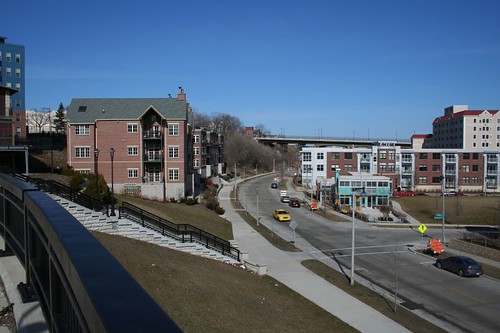
Commerce Bluff Condominiums

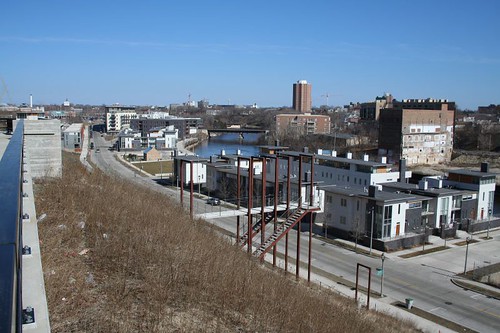
All the new construction has created some dramatic spaces. Commerce Street, formerly the site of some heavy industry and a rail yard, is a narrow slice of land sandwiched between a large hill and the Milwaukee River. The buildings that have gone up here since 2000 climb the hill, bury themselves into it, or perch alongside the river. Courtyards, porches, balconies, stairs and walkways create a layered pile of public and private spaces.
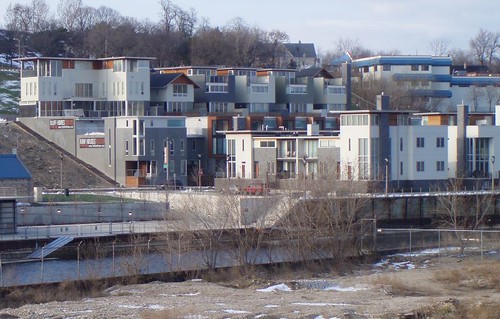
Condo Hill

One of the most exciting aspects of the whole development is just how much creative public infrastructure has gone in.
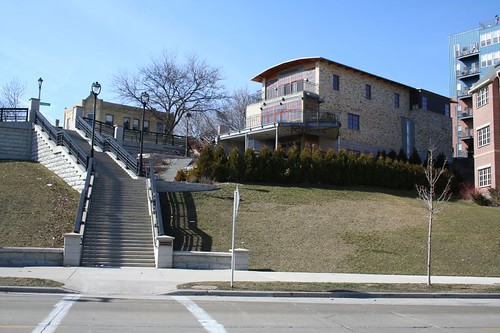
Stairs to Brewers' Hill

The monumental Vine Street Stairs from Commerce Street up into Brewer's Hill has poetic quotes inscribed on its risers.
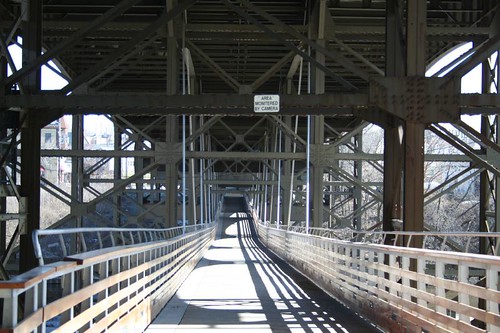
Marsupial Bridge

The much-publicized Marsupial Bridge, suspended beneath the Holton Avenue viaduct, is a unique public space. It gives not only a sheltered view of the river and its banks, but also a close-up look at the bridge's massive structure. On wet days, it offers bicyclists a welcome respite from the rain, as well as a handy shortcut from downtown to RiverWest. The gathering space at the east end still seems a little seedy -- even a well-landscaped space under a bridge is still under a bridge -- but has been used for a number of delightful little gatherings, such as evening movie screenings. Likewise, the bridge itself isn't quite as isolated as one might expect; it's much lower to the street and visible that one might expect - though a security camera monitoring one end still gives pause.
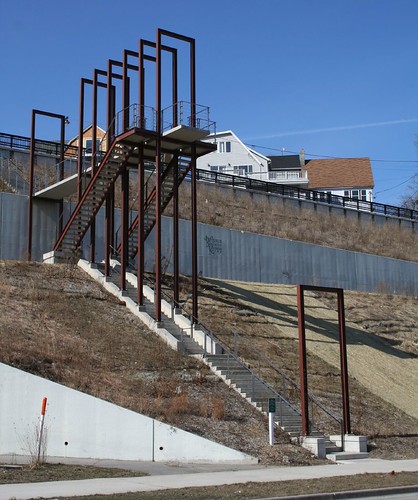
Milwaukee's own Rocky steps!

The Booth Streets Steps are another shortcut up the bluff to Brewer's Hill. They take dizzying flight into the sky before turning back and descending.
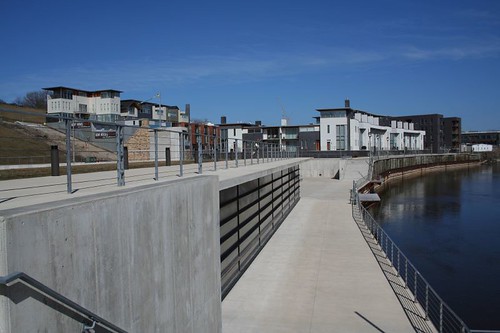
Riverwalk

The Milwaukee Rowing Club's new ultra-modern boat storage building stands along the river in a break between two of the condo developments. Its low height allows it to disappear entirely from the street, leaving only the grass-covered roof. At the river, it extends the RiverWalk into a low plaza. That plaza became the site of tragedy in 2004, when two young neighborhood girls drowned in the river while playing on the boat dock. Railings were promptly installed along the RiverWalk in this location, prompting many to wonder why they weren't there in the first place.
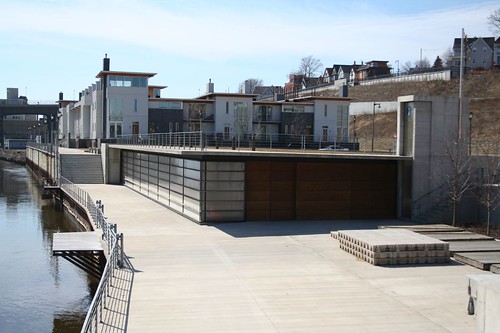
The boat house

North Avenue Dam bridge

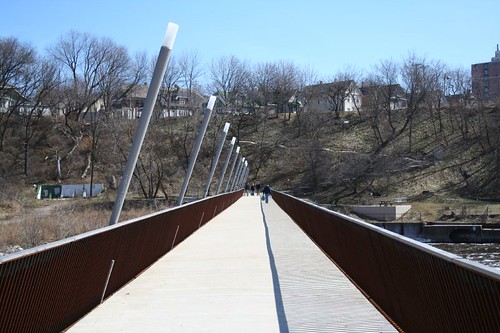
The North Avenue Dam, long ago broken to release the river from its captivity, has been put to creative re-use as the base structure for a pedestrian bridge. It connects Riverboat Road to Caesar's Park, a tiny slice of public land including the southeast river bank and the huge bluffs, climbed by a switchback trail. The bridge's style is as modern as the condominiums it serves, with sleek, elegant lamp posts and utterly simple railings.

Caesar's Park was rehabilitated around 2003; after years of being overgrown and potentially dangerous, much of the excess vegetation was cleared out, opening views across the river and eliminating the park's sense of dangerous isolation.


As for the condo buildings themselves, they're quite a mixed bag. Some are forgettable, one or two are rather dreadful, while several are delightful. It's a little heavy-handed to paint them all as sharing much in the way of style; they're all over the map.

Park Terrace Homes
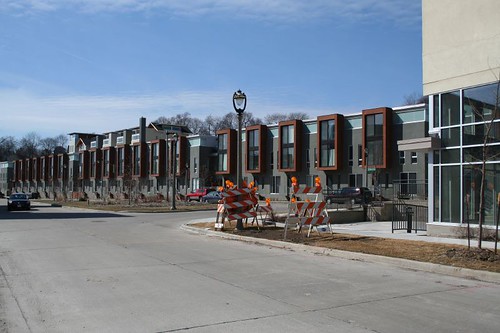
Park Terrace homes

My personal favorites may be the Park Terrace homes, a long line of identical slender row houses tucked into the hillside. I'm a sucker for marching repetition and shadowy articulation, and the Park Terrace buildings have both in spades.
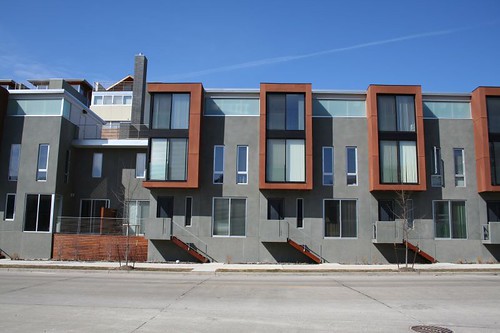
Park Terrace homes

The facade is a little flat and uninspiring when viewed head-on, but that's not how it's meant to be seen, nor how most people will see it. Most passers-by will see the buildings in profile, and that's where they shine.
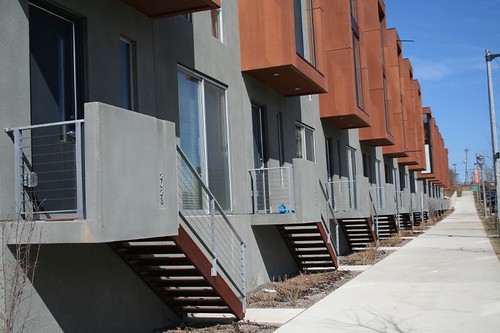
Park Terrace homes

More fascinating still, a second layer of houses stands further up the bluff, practical standing on top of the first-phase houses. A new road cut into the bluff leads in from North Avenue, serving both the basement-level garages of the upper houses... and the rooftop garages of the lower houses! The entire scheme is bold and audacious, a fascinating response to a difficult building site. (One hopes they got their civil and structural engineering in order, so the whole thing doesn't start creeping down the bluff or filling up with water every time it rains.)

Commerce Street, Milwaukee

Not only that, the structures are a rare example of modern development that actually lives up to its name. It actually is a terrace, and it actually is in a park!

The terrace


River Homes at Beerline
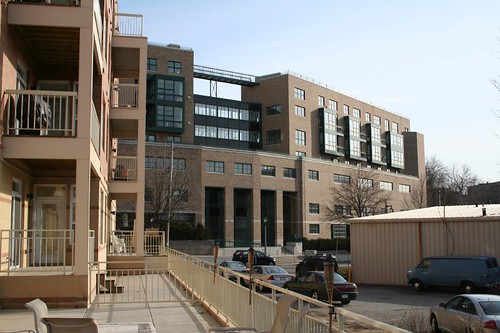
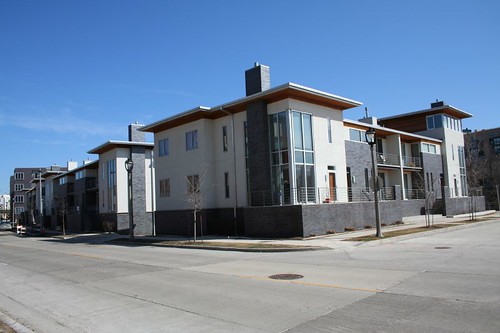
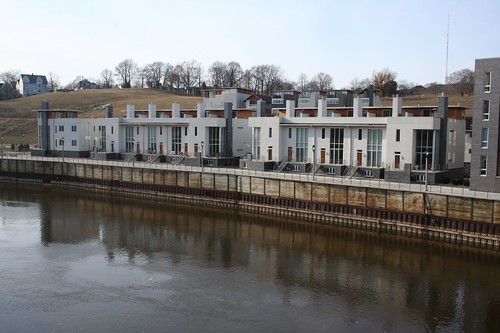
The River Homes at Beerline (see how many names you can squeeze out by recombining "River" "Park" "Homes" and "Beerline"?) line the Milwaukee River, and their terraces extend the River Walk ever closer to its ultimate destination of North Avenue. Sadly, they don't yet connect to the lengthier portions downtown, but hey, Rome wasn't built in a day.
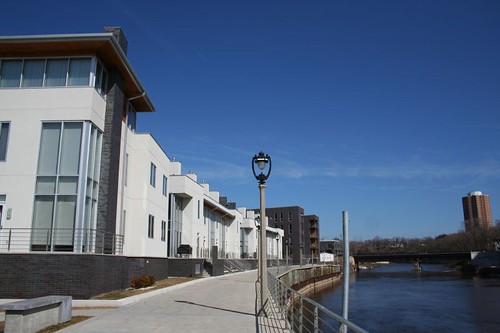
River Homes at Beerline

The River Homes are the earliest buildings here, and their modern stylings set the tone for many of the developments that came later. The buildings play with massing and materials; rectangular blocks overlap and intersect, while panels of brick give way to EFIS and wood siding as the buildings rise higher. Transom windows line pseudo-towers that rise above the building's mass at the river.
River Homes at Beerline

condos and river


Trostel Square
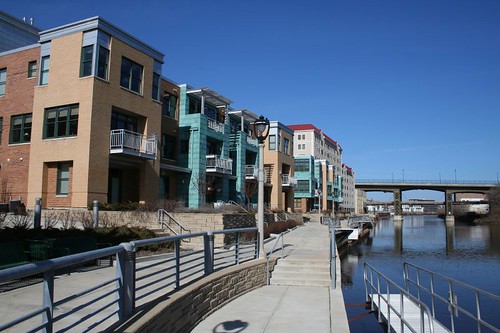
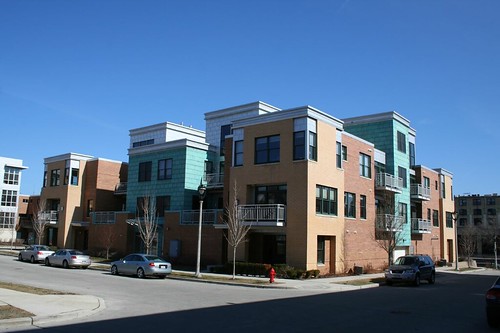
Trostel Square stands on the site of a former tannery near the western end of Commerce Street. Like River Homes and Park Terrace, the buildings are emphatically modern, clad in a mix of metal panels and brick laid out in patterns that declare the cladding's independence from structure, and massing made of overlapping rectangular prisms emerging from one another.

The buildings dare to use color, mixing light greens and oranges with brushed metal panels and red brick. It's a slightly awkward combination, but it brings welcome relief to what would otherwise be a very monochrome street.
Trostel Square

Trostel Square

Commerce Bluff
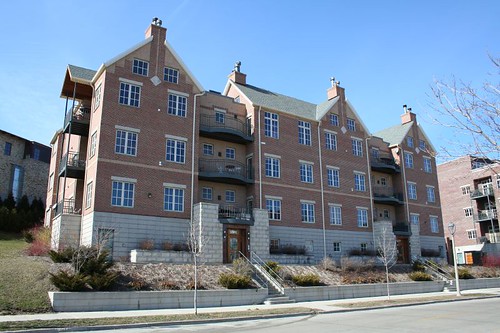
Amid all this unabashed modernism, the Commerce Bluff buildings are kind of a letdown.
Commerce Bluff Condominiums

Given a narrow site backed up against an insurmountable hill, a tall building was demanded. But the design here doesn't really celebrate that tallness. The gabled roofs seem to be taking a peck at historicism, but they just end up with blandness. A building that should be exciting simply because of its site and height instead is simply... dull.


Union Point
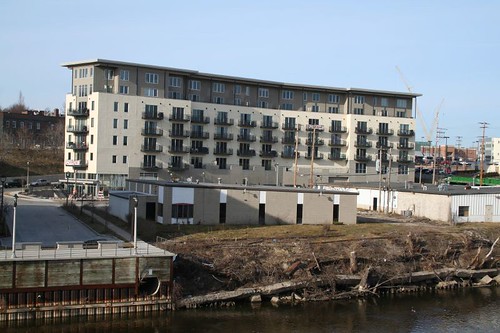
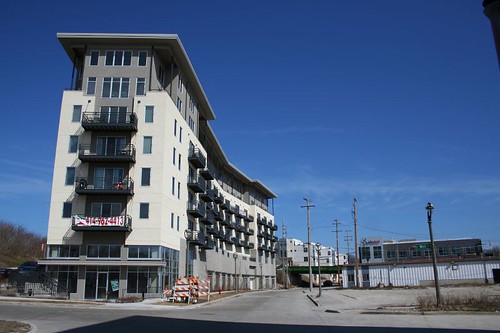
When people comment about how the new condos are "ugly" or whatever other derogatory term they want to use, I always kind of assume they mean the Union Point building. Festooned with tacked-on balconies and saddled with ungainly facade proportions, the building looks like it suffered a head-on collision with a budget shortfall.
Union Point

I will say this: it has a very impressive profile.
Union Point

It also adapts to its awkwardly-shaped site, turning a massive block into a block with a twist.

But those balconies just kill the whole thing. They're non-integral to the building in a way that's hard to forgive in a brand-new building, nor do they hold much appeal individually. If they'd been integrated into continuous bands -- as was actually done for the second floor, and again at the sixth -- they'd animate the building, bring controlled pattern and light to its surface, and a sense that the designer remained in control.


River Court
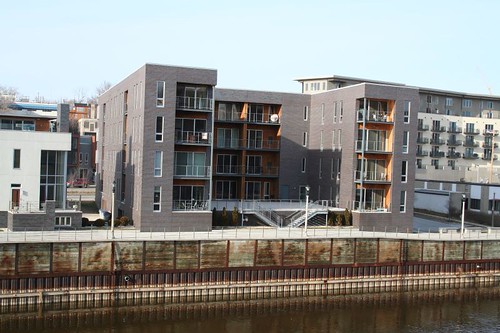
South of Union Point sits River Court, another project that actually lives up to its name: all the units face a central courtyard, which opens up to the river.
River Court

Here the intended effect seems to be a big solid cube of gray brick, which has been selectively cut away in places to reveal windows and wood finish beneath. Every element of the building is either "carved" from the mass or seemingly clamped onto it. It's an interesting concept (you see it a lot in architecture school projects) and has been carried out seemingly without compromise. The resulting building is a little hard to love -- it's cool and withdrawn and not terribly exciting -- but it'd hard to dislike it, too, and who can argue with that big courtyard?


RiverCrest Condominiums
The RiverCrest condominiums are another modern batch. Like the Park Terrace buildings, they are built into a steep hillside along the river. Like the River Homes, they play with massing and materials, piling rectangles high to the sky.
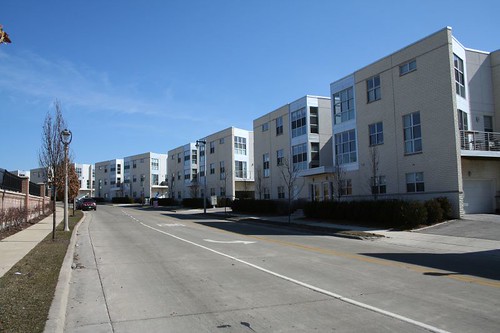
RiverCrest Condos

Most unusual on these buildings is the creme-colored split-faced brick. While perhaps intended to be a callback to Milwaukee's famous Cream City brick, for me it evokes nothing so much as the creamy-white brick popular in suburban houses of the 1960s that were shooting for the Camelot-era elegance of the time. Reinforcing that image is the stained wood garage doors.
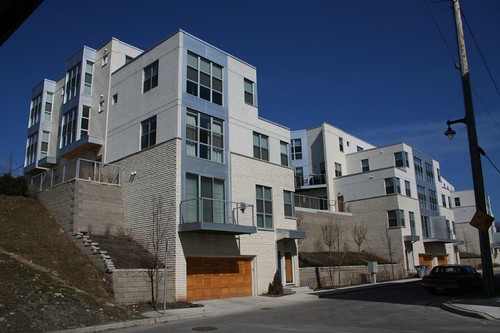
RiverCrest Condos

They also use the same carved-away trick as the River Court building, but to a lesser extent; side walls give way to recessed porches opening onto shared auto courts.

Riverbridge Condominiums
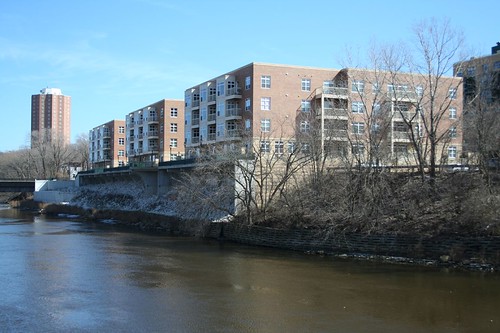
Riveredge

A rather plain bunch is the Riverbridge Condominiums, named for the adjacent Humboldt Avenue bridge over the river. Still, the bay window massing and integrated balconies are nice enough. The most dramatic views, however, come from the outside looking in, where one can see the riverside plaza supported on arching concrete cantilevers over the banks of the river. That terrace space is all semi-public, and perhaps one distant day it will be connected to the rest of the RiverWalk.
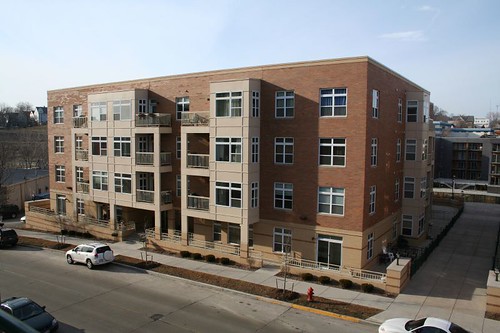
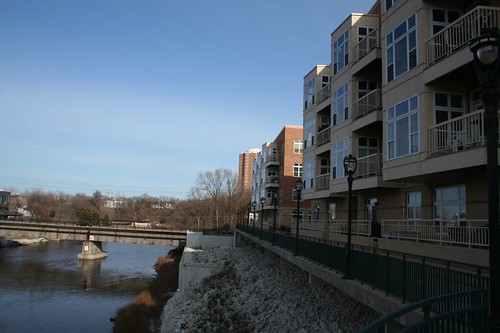
Riverbridge Condominiums

Riverbridge Condominiums


Highbridge Condominiums

Drama is the order of the day here, as yet another building tucks itself into a steep hillside. The Highbridge condos were the first to go up in this area, and still raise eyebrows with their soaring masses perched precariously on the hillside. There's something fascinating about the bay windows, which read as bits of the building's interior life bursting outwards, unable to be contained.

The building's massing is complex, with different pieces overlapping and saying different things: "grand entry", "quietly domestic", "holy crap I'm flying!"

Highbridge Condominiums

So steep is the site that the garage entrance is up top, from a dead-end street in the middle of the older neighborhood just north of Brady Street. At ground level, they're friendly enough, though the rest of the street isn't too inviting at present.
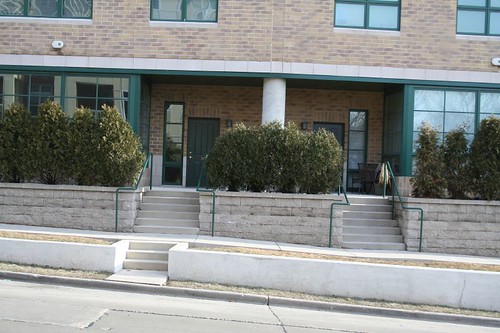
Highbridge Condominiums

Highbridge suffered some rather infamous post-construction problems that led to a lot of lawsuits and misery.
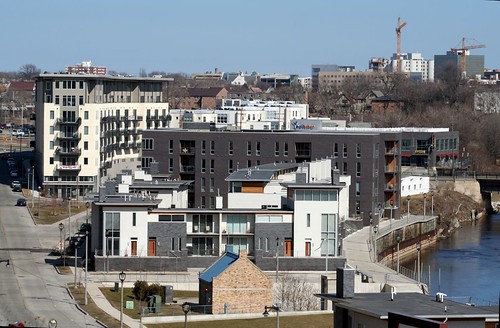
Commerce Street

So, yeah, I really like the Valley of the Condos. It's an exciting place, unabashedly new and modern, friendly and welcoming to bikes and pedestrians, with some of the best public space in the city.

Links:
  • Milwaukee Department of City Development Beerline B page
  • Thursday, October 23, 2008

    Bye-bye baby blue

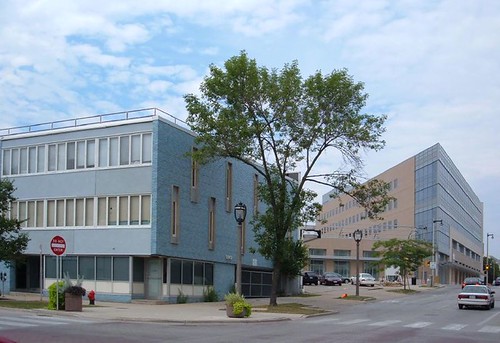
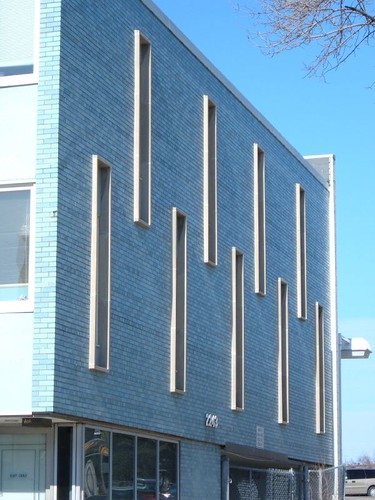
    Much as I hated to admit it, I always figured that the blue brick Midcentury building at North and Prospect would be coming down. Sitting adjacent to an empty gas station and its own parking lot, it'd be an easy sacrifice to make, to allow combination of the lots and creation of one large building site.

    I was right... and I was wrong.

    The blue brick building, Milwaukee

    Blue building site

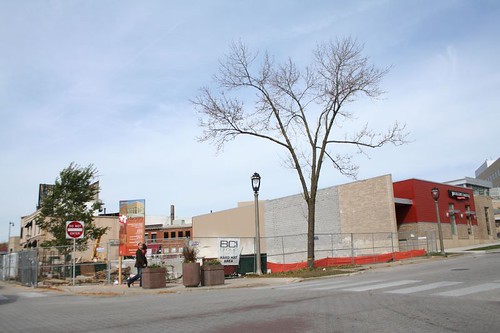
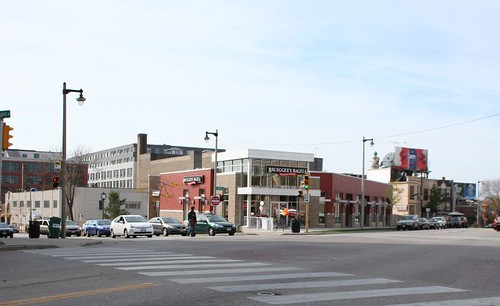
    They tore down the blue building, alright -- much to my regret. But in its place is coming... a building of similar mass and footprint. Meanwhile, the gas station lot has got its own building already, a brand-new Bruegger's Bagels.

    Whahhhh?

    North & Prospect

    Make no mistake, this is definitely an improvement over the vacant gas station (even when it was occupied.) But... I'm a little surprised that something more ambitious didn't arise here.

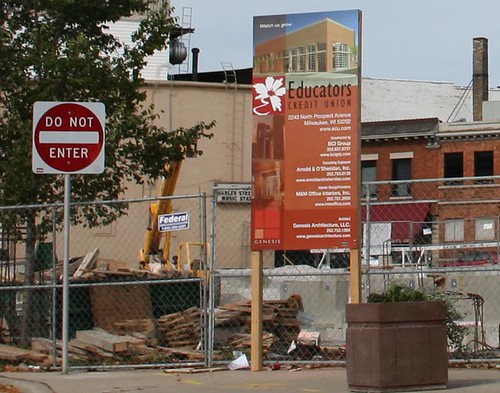
    Meanwhile, the blue building will be replaced by a new branch building for the Educator's Credit Union. Trading out a two-story building for a one-story building? How does that work?

    Coming Soon

    The new building is purported to be a Prairie Style structure, though it's hard to discern from the rendering shown here. The architect, Racine's Genesis Architecture, does show some beautiful Prairie Style work on their web site, so perhaps it's just down to my crappy photograph of the sign.

    But I miss the blue building. It's yet another case of tearing down something not just because it's old, but because it's the wrong kind of old. We need a new old instead, an older old! The style of forty years ago is never new enough, and never old enough. By the time Midcentury Modern has aged enough to be old, valued and historic, by the time we're far enough removed from its time to look back on it with fresh eyes and truly appreciate it... Milwaukee will have torn it all down.

    Blue brick

    Additionally, if the building absolutely had to go... I really wanted one of those bricks.

    Tuesday, October 21, 2008

    90 miles apart

    Being in Milwaukee this weekend made me acutely aware of some of the differences between it and Chicago. It's more than just a matter of scale. The difference of size causes different attitudes, different mentalities.

    Milwaukee is a city that's still close to the land. It is shaped by topography, sitting atop 80-foot high bluffs that overlook Lake Michigan. It's a small city, small enough that people who essentially live out in the country can take part in its daily life, and people who live in the city have many options for outdoor sports and activities. That connection gives it an often rural attitude. People in Milwaukee come from small towns. They root for the Packers -- it's not just a cliche. They hike and fish and hunt and backpack and camp and canoe on their weekends. That same rural attitude, applied to city living, gives the city an air of smart environmentalism; it also means that Milwaukee sometimes fights against its own nature as a city (just look at the hew and cry over bus funding and rail transit, or the reluctance to convert 794 to a surface parkway, or the fuss over tearing down a useless stretch of highway, or...) Milwaukee is a small niche of the (reluctantly) man-made perched among the vast wilderness of Lake Michigan.

    Chicago by contrast has long since conquered nature, which is sequestered away in distant woodlands known collectively as the Forest Preserve. Chicago's Lake Michigan coast is entirely artificial, constructed over a hundred years of city-building, and gives an illusion of control over the vast body of water. The city sprawls for thirty miles in every direction, ensuring no easy escape from its artificial environment. The resources of the Great Lakes funnel down to Chicago, which is the drain through which they flow, the sieve that sorts them, the mill which grinds them up and churns out product. Chicago is less a part of Lake Michigan and more an engine strapped to its side, converting its resources to commercial goods and fountaining wealth across the region.

    At their cores, the cities may seem similar -- glistening downtowns perched on idyllic lakefronts (indeed, Milwaukee's lakefront is no less artificial than that of Chicago.) But the difference is in how they spread themselves across the land. In barely five minutes of driving north from downtown, Milwaukee's Gold Coast high rises give way to single family homes, and five minutes after that these houses gain their own private beaches and forests. By Whitefish Bay, the view up the coast is essentially the same as it will be for the next hundred miles. One must travel a good ten miles north of central Chicago to find a single-family home with a lake view. Milwaukee is a short interruption of nature; Chicago is its own nature.

    Thursday, October 02, 2008

    A south side mystery

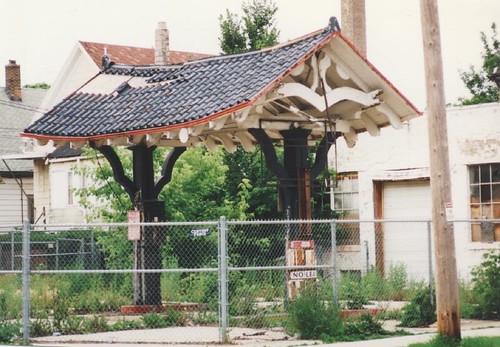
    Wadhams Gas Station

    It began with a photo on Flickr, showing the well-known brick wall on 1st Street where a Wadham's gas station pagoda once stood. The building's outline remains embedded on the wall, along with part of a painted sign.

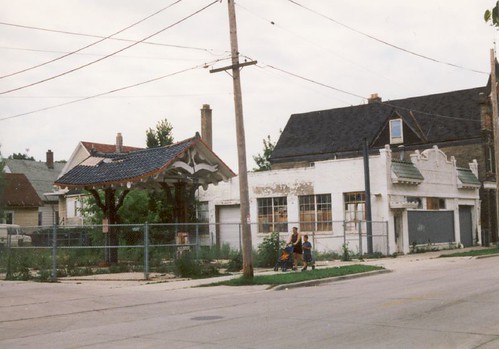
    "Oh," I commented. "I have a photo of that when it was still standing." But a dig through my film archives showed no such thing. Apparently, I was thinking of this place instead, which I photographed in the summer of 2001.

    I have no idea if it was a Wadham's or not. I'm not even sure where it stood -- somewhere between the Modjeska Theater on Mitchell Street, and St. Hyacinth's a few blocks south on Becher Street, to judge by the before and after images on my negatives.

    Wadhams Gas Station

    Where was it? What was it? I turn to my readers for answers -- I have none!

    Monday, July 21, 2008

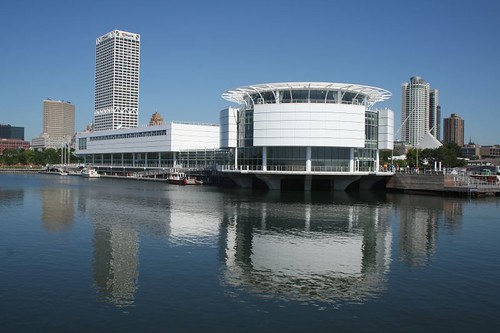
    Discovery World

    View from the new breakwater

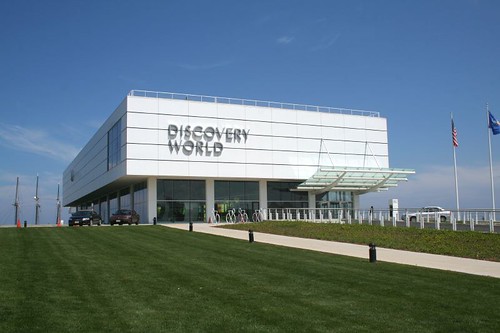
    It's hard to argue with the new Discovery World building. From the outside, it's a knockout from every angle. It's a beautiful compliment to the Art Museum addition, without aping it.

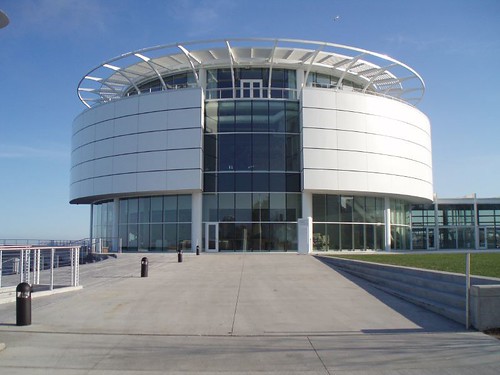
    I visited Discovery World about a year ago, and got to see how the inside relates to the outside. The building's functions are expressed well from the outside, about... 75% of the way through, I'd say.

    Discovery World

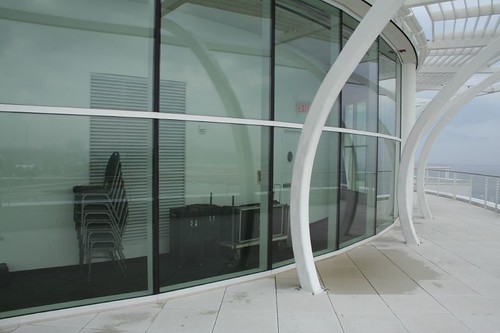
    The Headhouse is clearly distinct as a gathering point, a circular structure with balconies at the top. Those balconies surround a ballroom/meeting space, and provide spectacular views of the city, the lake, and the new harbor to the south. An awkward moment does occur when storage space winds up being placed on the outside of the third floor space, complete with windows and a view of the harbor. Oops! It might have been better placed in a block with the elevators nearby -- service functions like that should be grouped; it's a basic rule of thumb. It also emphasizes some of the inherent difficulty of a round building.

    Lucky tables and chairs

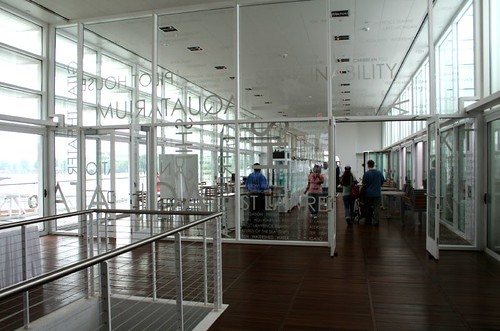
    The main body of the building is laid out along a broad, tall corridor lined with windows facing the bay to the south, an attractive and open space that provides easy orientation.

    The glass tube

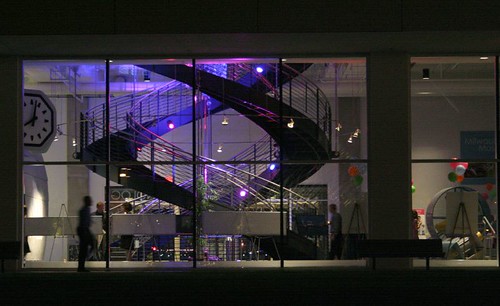
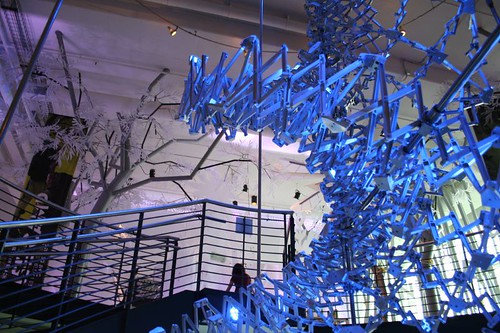
    At the end, one turns right and enters the primary exhibit space, which is dominated by a double-spiral staircase with an elaborate moving model in the center. A window wall to the north provides continued orientation, and creates a delightful view of the colorfully-lit model by night.

    Glowing in the night

    Discovery World

    Past this point, however, clarity starts to fall apart. A second room on the first floor kind of dead ends. The main room on the second floor is a bit chopped up by its exhibits, with no clear main circulation path. Classrooms and other interactive areas are accessed through an odd hallway that makes one hesitate to proceed, uncertain if they're headed toward a mock TV studio, the corporate offices, or the boiler room. It was at this point that I got the impression that this portion of the building had been designed from the outside in, rather than allowing the functions to generate the plan, and the exterior form to follow from that.

    Some of the second floor exhibits were still under construction when I visited, so it's possible things may become more clear with time. Some bold signs would have gone a long way toward clarifying what was where.

    Outside, the building and its grounds succeed brilliantly. What was once a completely forgettable section of the lakefront is now fully integrated with the parks and museum to the north, and the newly-opened Lakeshore State Park and the Summerfest Grounds to the south.

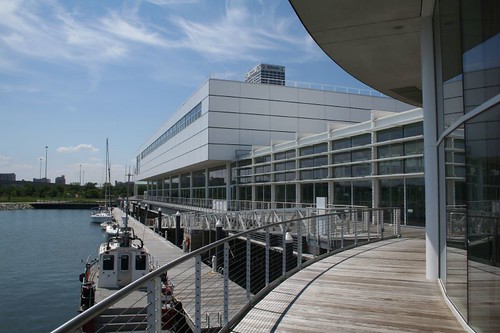
    Facing the new harbor

    The building's water-facing sides are wrapped with cantilevered walkways, offering exciting views of the new harbor and the lake waters to the south. The walkways hook up with a new breakwater with attached docks and a small connected amphitheater. The amphitheater faces a new dock for the sailing ship Dennis Sullivan. It's a brilliant expansion of Milwaukee's already-magnificent lakefront, and adds a worthy attraction to the lakefront's offerings. In light of that, a few architectural flukes are pretty negligible.

    Discovery World

    Wednesday, July 16, 2008

    Amtrak Station burdened by junk

    Amtrak station

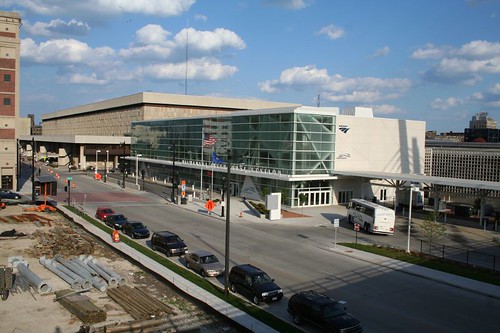
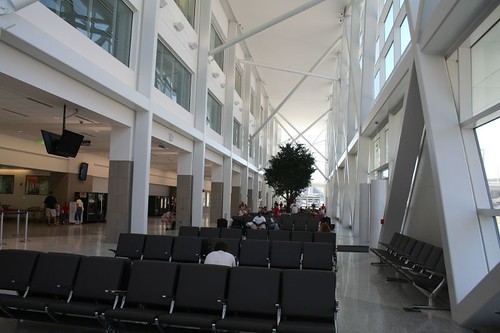
    I recently visited the spacious new waiting room of Milwaukee's remodeled passenger depot. Perhaps "depot" is a poor choice of words, because the building no longer treats passengers like cargo. The dark and minimal waiting area has been replaced with a vast, bright and airy space.

    The Waiting Room

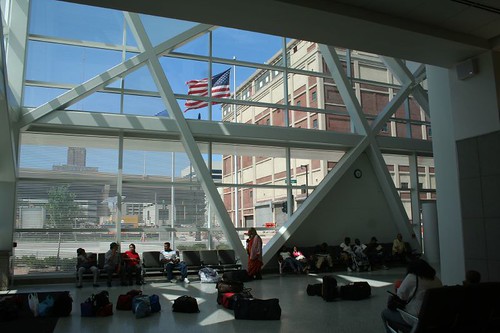
    As a consequence of the narrow space available for the expansion, the waiting room features a strange set of proportions. It is as taller than it is wide, and very long, running uninterrupted for the 300-foot length of the building. The pick-up-sticks wall of angled steel box beams begs to be beheld from a distance, to be appreciated in its entirety, but it's not quite possible with the room's narrow width.

    Still, it is an airy and comfortable space, open and inviting, big but not overwhelming, much like Milwaukee itself. The white color continues a trend started by several of the city's most prominent new structures: the Art Museum addition, the 6th Street viaduct, and the new Discovery World building.

    Functionally, the space breaks up into three parts. The western half is used for Greyhound passengers; chairs ring a large open area. The center portion is a general dining/communal area, designated by three tall trees and round tables. The eastern half is for Amtrak passengers, and is marked by multiple rows of chairs.

    The Window Wall

    This is not a pristine space; it is of course meant filled with chairs. Several large potted trees enliven the center of the space, breaking up the room's endless length. And the crazy-quilt structure of the window wall itself suggests some of the chaos naturally associated with travel. Yet there is something clean and crisp about it, and I was disappointed to find that the management has seen fit to clutter the entire space with junk.

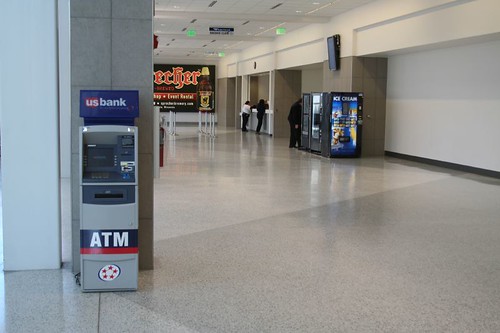
    Junk

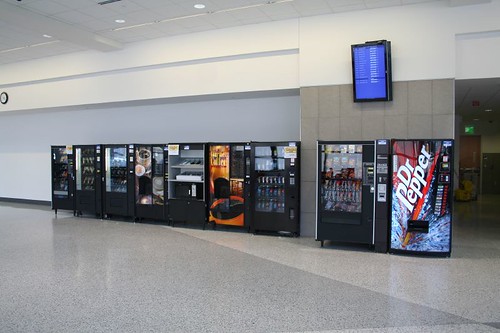
    More junk, and soda.

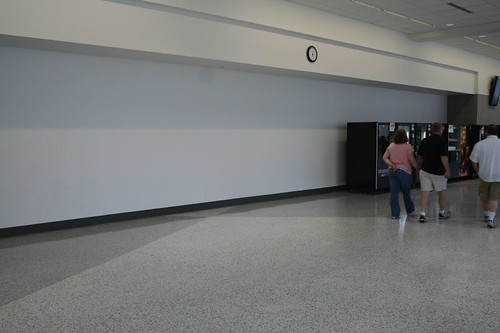
    Much of this detritus was clearly not planned for, and was added after the fact. That monster game machine really should have its own dedicated space, in a game room somewhere (it makes a lot of noise as well, disturbing the peace of everyone waiting to travel.) And while trash cans and ATMs are necessary accoutrement of everyday life, there are ways to deal with them more elegantly than to jam them up against every available column.

    One of those ways, for example, is to provide a dedicated alcove for objects like vending machines. It's not beautiful, but at least it gets them out of the way. And it seems that someone had this in mind... but somewhere in the planning process, the fact that vending machines require electricity wasn't accounted for. And thus, while an alcove big enough for twenty soda machines does indeed line the south wall of the waiting area, it's empty, because there's nothing to plug the machines into.

    Connect the dots

    Instead, they cluster clumsily around the ends of the alcove, butting out into the concourse area, not only looking ugly in their own right but giving the space the sort of ad hoc messiness that really shouldn't be present in a freshly remodeled building. Even allowing for the mistake of not including enough outlets, one would think that fifty dollars would be available to pick up a couple of extension cords and get the machines into the alcove where they belong.

    And more soda.

    Attempts to lure a full-time restaurant to the station have not met with much success, but with this phalanx of vending machines, the station already has the equivalent of a small 7-Eleven.

    My one other criticism with the station's interior pertains to the Greyhound end of the waiting area. Travel by Greyhound is a catch-as-catch-can affair; one must wait in line to be assured of getting a spot on the bus. To that end, passengers typically use their luggage as a stand-in so they can sit while waiting. The open space of the waiting area serves this need adequately, providing plenty of seats surrounding the luggage line-up that allow passengers to keep an eye on their bags. Yet it remains a chaotic solution, and I wonder if other, more elegant alternatives were explored (integrating the line with the waiting room chairs, for example, or a numbering system.)

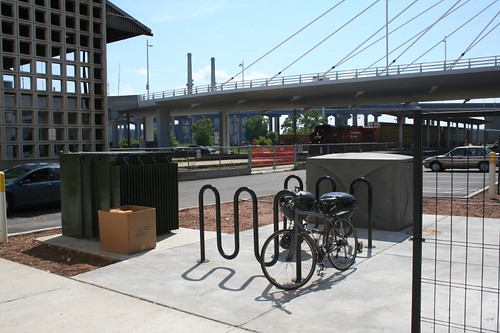
    Outside, it took a little bit of searching to locate the bike racks. They're tucked away behind the Greyhound boarding area on the building's west end, out of sight from the road (and nearly everything else.) I'm not sure how I feel about the arrangement; while it doesn't advertise the presence of locked bikes to passersby, it also doesn't seem to be a very well-watched area.

    Hidden bike racks

    The bike racks are correctly installed, with plenty of room on all sides, and they are the multiple-U racks which are ideal for parking any type of bicycle. Having any racks at all is a great step up from the state of affairs during the renovation, and I do appreciate that bicyclists were given this thoughtful parking arrangement.

    Criticisms aside, the new waiting area is a welcome addition to the Milwaukee traveling experience. Hopefully the building's management will soon relocate some of the clutter that's currently dragging down an otherwise pleasant and modern space.

    Tuesday, July 08, 2008

    Pritzlaff Hardware Building

    Just across the river from the 3rd Ward is this monster of a building complex. The original two portions, with their endless marching windows and bays, were begun in 1875 as the Pritzlaff Building.

    Pritzlaff Hardware Building

    The building originally held a hardware company that, in time, became Milwaukee's largest. The enterprise was begun by John Pritzlaff, a Prussian immigrant who arrived in Milwaukee in 1841. In 1850 he started his hardware company, which would eventually become one of the largest in the Midwest, employing some 400 persons at its peak.

    Leaving its original home on 3rd Street (still extant today), the company moved south to a site with railroad and river access. The new building was designed by John Rugee. The center portion of the east facade, dated 1875, came first; the corner portion to the north was likely the next addition. Overall the building was expanded at least three times, in 1916 among others, into a 300,000 square foot complex.

    Pritzlaff Hardware Building

    Pritzlaff's son Fredrick would continue as president of the company until 1951; Frederick's son and grandson also entered the business. However, by then the company was in decline; it closed its doors in 1958.

    The buildings then became home to Hack's Furniture, who applied their own painted signs to its vast walls of Cream City brick. Hack's closed in 1984, but a family-owned storage business moved into the building.

    Pritzlaff Hardware Building

    The buildings were most recently occupied as a furniture store (The Mattress Store) and for storage, but have been largely vacant and underutilized for years. By 2000, the building was under consideration for conversion into a residential space, but no developers were willing to step forward, daunted perhaps by its considerable size.

    Six years later, however, Sunset Investors got the ball got rolling on a massive renovation, cleanup, and remodeling. The building is now being converted to a mixed-use project, including 86 condominiums, retail, office space, and a new parking garage that has yet to be built. The project is being overseen by Brookfield design firm Cityscape Archtecture.

    The renovation has cleaned the public faces of the building, washing away heavy layers of grime and soot accumulated in its 130-year history. The change is remarkable, letting the building's architectural beauty shine through unblemished.

    Pritzlaff Hardware Building, spring 2000
    East elevation in March 2000

    Pritzlaff Hardware Building, summer 2008
    East elevation in June 2008

    While the renovated facades look unquestionably great, it is still a bit sad to see the building's physical history scrubbed away, losing the appearance of a building unaltered for a hundred years. The building has also lost the 1950s painted signs from the Hack's Furniture days.

    Pritzlaff Hardware Building
    North/west elevations, July 2005

    Pritzlaff Hardware Building
    North/west elevations, July 2008

    Various painted signs for Pritzlaff Hardware remain on the back of the building at present, though the renovation may claim them as well. Some are over a hundred years old; it would be an unfortunate loss.

    Pritzlaff Hardware Building
    Above: a painted Pritzlaff Hardware sign on one of the original buildings was partially covered over by a western building addition.

    The building's street facades are nothing short of remarkable. The various additions over the years are unified by their Cream City brick construction, and range in style from ornate Italianate to the largely unadorned 7-story addition to the south. An amazingly long line of windows marches down the Plankington Avenue side, beautifully rhythmic, their sheer number hinting at the heights of prosperity and money that drove the building's owners.

    3rd Ward Multiples II

    The building is remarkably well preserved, its cornice and Italianate brackets unaltered since their original 1875 construction. It street level storefronts are likewise virtually unaltered; the renovation has removed the various ad hoc alterations that did accumulate over the years, leaving a clean and lovely street facade.

    Pritzlaff Hardware Building

    Seeing this building renovated and on its way back to life is nothing short of uplifting. In its sheer size and power, it is one of the city's most remarkable structures.

    Pritzlaff Building

    Wednesday, June 25, 2008

    Teweles Seed, before and after

    Continuing to muck around in the eastern end of the Menomonee Valley....

    Teweles Seed, pre-renovation

    This was Teweles Seed Company in 2003 -- a grungy-looking, ragged old industrial tower from 1918, in brawny concrete and battered brick and glass. The grounds were deserted, home to liittle more than ancient abandoned trucks and dumped tires.

    Teweles Seed, post-renovation

    This is the Teweles building today - remarkably renovated into rental apartments, with a shiney modern penthouse addition up top.

    It's way too easy to romanticize decay, to lament the passing of the old industrial face of Milwaukee and bemoan the coming of the dreaded condominiums. Don't fall for it. The City Needs More People -- this is the infallible mantra of the savvy urbanist, and will be for many, many years to come. This part of the 5th Ward is a frontier now, but check back in five to ten years and by rights it should be bustling.

    (All that said, they seem to be having quite a few management problems.)

    More before and after shots may be seen here.

    Saturday, June 21, 2008

    Harley Museum rising

    Harley Davidson Museum

    Long anticipated, greatly hyped, the Harley Davidson Museum is nearing completion. It's slated to open on July 12th.

    Harley Davidson Museum

    It's a sharp looking piece of modern design, courtesy of New York City's Pentagram Design. Its factory-like aesthetic fits nicely into the Menomonee Valley, long the city's industrial center.

    The campus is a bit sprawling for my tastes, but at least down in the Valley it's not taking away from denser areas. The Menomonee Valley is, by its nature, a large gap in the city's urban fabric. With no plans to change that, it's as good a place as any to host the museum, and having this sort of draw close to downtown is a definite plus.

    Harley Davidson Museum

    I'm very pleased to see the riverside landscaping and paths that have been included as part of the campus; presumably these will extend the Valley's biking and walking trails further east. They form a sharp contrast with the brutal rear wall of the main Post Office building across the river, showing just how much attitudes toward the river have changed in 40 years.

    Harley Davidson Museum

    As for the building itself, Whitney Gould summed it up nicely two years ago: it's no Calatrava-aping showstopper, but it's taut and disciplined, cooly and respectably modern. I look forward to seeing the interior, and what spatial surprises await within.

    Saturday, June 07, 2008

    5th Ward Building Collapse

    The Journal-Sentinel reports that the Phillip Weimer Building, at 6th Street and National Avenue, has suffered a major roof and sidewall collapse amid today's heavy rains.

    Phil Weimer Building
    June 1, 2008, just a week before the collapse. The small house at right was largely destroyed by the collapse.

    The 1892 Romanesque building is part of an amazing lineup of Victorian commercial buildings at the intersection and in the surrounding blocks, and is listed on the National Register of Historic Places. Its loss will diminish one of Milwaukee's major historical treasures. The front facade, at very least, should be preserved.

    Phil Weimer Building
    October 2006

    Originally built to house a wine and liquor business, the building was most recently home to the Acapulco Lounge, which was closed for renovation. A small fire was reported, but quickly snuffed by firemen. No injuries are reported.

    Phil Weimer Building

    Post-collapse photos may be seen here.

    The Corpse of Prospect Mall

    Prospect Mall has been sitting empty for nearly two years now. In 2006, the mall booted out its last few tenants (the Chocolate Factory, a used bookstore, a dismal first-run movie theater) and turned out the lights. What could be done with this vacant hulk?

    Prospect Mall

    My first thought was to turn the whole thing into a movie complex. Gut the interior completely, add more screens, completely renovate everything. Add in a couple of restaurants facing a luxurious interior lobby space for a complete all-in-one stop for an evening on the town. Don't make it an interior arcade -- the building's too small for it to work. Make it one single space, lined by storefronts. The East Side already has two great theaters, but they're focused on art house films. A first-run theater might do well, especially if it was maintained to high standards, unlike the ratty Prospect Mall Theater.

    Prospect Mall

    My second thought: tear the whole thing down. There's an old brick building under there somewhere, but as it currently stands, the exterior is an EFIS-slathered nightmare, and the interior is a badly dated 1970s attempt at rustic ambiance. The lot is big enough to support something massive, a 5- or 6-story building with retail all around the base. There's no shortage of market demand for the area.

    But when I went to get photographs, I discovered that, hey, the brick building might be something pretty nice:

    Prospect Mall

    That's some handsome brickwork. That's worth saving.

    So now I’m back to my first position: gut it. Redo it. Take off the awful EFIS cladding; repair the brickwork (the building housing World of Wings a quarter mile south offers a perfect precedent.) Restore the storefronts, tie the building into the street, set up a small but quality first-run mainstream movie theater within.

    And by doing so, get the black hole out of the East Side's heart.

    Friday, June 06, 2008

    S.G. Courteen Seed Corporation Warehouse

    If you've ever driven south from the river down 2nd Street, you've seen this monstrous mountain of a building, its wedge-shaped form cutting an 11-story slice into the sky.

    S.G. Courteen Seed Corp. Warehouse

    Like a heavy-duty iteration of New York City's Flatiron Building, the knife-edge end of the Courteen building seems to lead a parade of industrial architecture up from the 5th Ward.

    S.G. Courteen Seed Corp. Warehouse

    In fact, the narrow end is the back side of the building. The front faces south, on Pittsburgh Avenue, and is rather tame by comparison.

    S.G. Courteen Seed Corp. Warehouse

    The building's original owner went out of business in the 1960s. Not much seems to have been done with the property since then, but a lack of boards and broken windows indicates some form of use and occupancy. Its owner proposed a residential redevelopment in 2006 (see article linked below), but to date only minimal work on the building is visible, mostly along the roofline. Delays in commercial development are extremely common, however, especially in the financing stage; it could still be coming. Hopefully it won't involve chopping up those amazingly huge Cream City brick walls.

    S.G. Courteen Seed Corp. Warehouse
  • Aerial view from Maps.Live.com.
  • After 40 years, Thatcher plans $40 million project - February 2006 Business Journal article
  • Tuesday, June 03, 2008

    Bradley Tech: the old and the new

    This blog's ostensibly about architecture, but in truth I'm so preoccupied with matters of urban design and historic preservation that I almost never get around to actually talking about architecture. So let's rectify that, shall we?

    But first, a topically related preservationist lament:

    Bradley Vocational Technical High School

    At the intersection of W. Bruce Street and S. 4th Street, where the massive Bradley Tech High School once stood, remains nothing but an empty field of mud.

    Bradley Vocational Technical High School

    Bradley Vocational Technical High School demolition

    I was disappointed that nothing was preserved from this building, which came down in 2006. In particular, the west entrance formed a brilliant termination to Bruce Street, a grand civic statement now lost and not guaranteed to be recovered in whatever eventually takes shape on the site.

    Bradley Vocational Technical High School

    Bradley Vocational Technical High School

    The old building was an enormous structure, built in several stages beginning around 1906 as Boys' Tech, and filling more than a city block. It was intimidating but grand; built in sections as it was, surely some of it could have been gutted and reused. The site as currently planned will serve as athletic fields for the school.

    Bradley Tech

    The new Lynde and Harry Bradley Technology and Trade School, meanwhile, sits immediately to the south, facing W. National Avenue betweeen 3rd and 4th Streets. The building consists of a round-roofed section, flanked by two more standard box-shaped wings. It is seductive with its strong forms and shiny materials. However, I was rather confused by what I could make out of the interior.

    Bradley Tech High

    The exterior of the building is a classic Modernist Big Idea: we're gonna make this thing a half-cylinder, lying on its side, intersected by a series of vertical masonry cores. It's bold, it's powerful, it's iconic. Ordinary buildings are based on a floor plan which is then extruded vertically, but this one's a giant hoop, extruded horizontally. That's the Big Idea, the image you see from the street before you ever set foot inside. The result of that idea is that the building should be sectional -- elements that occur at one end should carry through the length of the building. The curve of the roof should provide the basis for orientation throughout the building. However, from what I could see from the outside, the building doesn't seem to work that way.

    Bradley Tech High School

    One end of the cylinder has a massive open atrium, the width of the building. This portion does indeed take full advantage of the building's iconic shape, with the curved roof exposed high above the entry doors, and a massive wall of north-facing glass filling the space with light.

    But south of that, it's solid labs and workshops (and, presumably, corridors.) The raw metal cladding of the cylinder ends before it reaches the ground, leaving a narrow exterior passage framed by curving structural members, but this is the only sectional element I could discern from the outside. Viewed from the inside, the Big Idea gets lost.

    Bradley Tech High School

    What else could have been done? Historically, a big, odd shape like a cylinder denotes a large open space -- a gymnasium or an auditorium (or an atrium). Curves are odd shapes -- computer age or not, we still live in a world of orthogonal construction. So you don't want to have to cut walls off to meet them or have glass made to fit their varying profiles. You wanna enclose it once and not touch it again. And the curve is a special shape, so it should remain visible; you don't want to bury it under a dropped ceiling.

    Bradley Tech High School

    So, the building could have been designed as a "building within a building" -- classrooms pulled back from the exterior skin, window walls along the classrooms allowing outside light to filter in, mezzanine balconies replacing typical hallways (enclosed in glass, of course, since the last thing you want to give a bunch of high school kids is the irresistable chance to drop things on their classmates three stories below), all of it opening onto a multi-story windowed west wall. Let that strange curved roof play through on the inside as well as the outside.

    Why didn't it play out that way? Could have been any number of reasons. Big atriums require a bigger building. Big buildings cost more money to build, maintain, cool, and heat. But if that ended up being the case, why use a form that screams out "sectional building"?

    Some of the oddness also comes to light in the meeting of the cylinder with its two adjoining wings, which are both more traditional in form.

    Bradley Tech

    Bradley Tech High School

    I may be coming down a little hard on this building. Compared to about 95% of the blobby nonsense that's hyped up in the glossy magazines these days, it's utterly practical, and unlike a lot of ultra-modern glass containers, it does have a strong visual identity, a sense of form and mass. Without that cylinder, the building wouldn't be nearly as memorable. But it does seem to suffer from a similar problem as the blobs, wherein a sexy shape is selected for the outside, and then the inside is compelled to fit within.

    Bradley Tech High School

    Monday, June 02, 2008

    Milwaukee's new Amtrak station has a bizarre problem

    In town this weekend, I briefly stopped by the newly completed Amtrak station. It looks pretty sharp. I felt a subliminal sense of letdown that the whole area wasn't magically transformed into some majestic gateway to the city, but that's far to much to ask of one little building. The traffic flow, the loading areas, and the existence of a waiting area with natural light are all a huge improvement over the pre-renovation depot.

    Amtrak Station renovation complete

    Didn't have time to go inside, sadly. But I did notice something very strange on the glass facade:

    What.. the.. hell?

    The seagulls, it would seem, have been leaving presents for Milwaukee travelers.

    It looks like they must perch on that little L-shaped ledge, with the step up creating a nicely secure spot for them. With downtown's itinerant gull population most recently displaced by the Harley Museum, it's not too surprising that the gulls would quickly latch onto a new perch. I didn't see any while I was there, but my visit was too short to be a representative sample. And if they're not perching there, then they must be dive-bombing it, which... well, that's just too bizarre to fathom, and the marks don't look right for that anyway.

    There's a simple and unobtrusive solution, fortunately. Expect some bird spikes to show up on the station's roofline shortly.

    Friday, April 04, 2008

    Retro post #4: Mother of Good Counsel Church

    Before I started this blog, I made a few posts about Milwaukee on my St. Louis blog. I'm reposting them here where they're more relevant. This one went up on June 23, 2006.


    Mother of Good Counsel Church, Lisbon at 70th, Milwaukee Wisconsin. Built 1966-68.

    How have I never seen this place before???

    It's a beautiful massing of a curved brick screen wall, capped with limestone and studded with protruding bricks, behind which stands a diamond-shaped sanctuary with narrow bands of stained glass.


    Next to it is a small parish office building, which brings together a number of fairly typical Mid-Century design elements (the vertical pier intersecting the horizontal plane, the rectangular cutouts, the limestone surrounds), but in an unusually high density -- and with a couple of elements I've never seen before.

    Most flabergasting is this original doorway:


    I can't believe they designed this -- let alone that it's still here 40 years later. Magnificent!!

    Click the images for more photos.

    Thursday, April 03, 2008

    Retro post #3: Goodbye and good riddance to the Whaling Wall

    Before I started this blog, I made a few posts about Milwaukee on my St. Louis blog. I'm reposting them here where they're more relevant. This one went up on May 10, 2006.

    Milwaukee lost an iconic landmark this week, and I couldn't really care less.


    The "Whaling Wall", a mural by an artist known as Wyland, adorned the Milwaukee County Courthouse Annex since 1997. It was well-known due to its position above the heavily-traveled lanes of I-43 southbound. There's been some hemming and hawing about losing the mural, which was demolished this week along with the last remnants of the aging, decaying Annex, a 1960s parking garage with a level of offices on top.

    Frankly, I say screw the wall.

    There are no whales in Milwaukee. In the wild, there are no whales within a thousand miles of Milwaukee. There is no aquarium here (well, that's due to change this year with the opening of the new Discovery World building, which will feature a modest aquarium.) The whale mural, basically, has jack all to do with this town.

    It is simply an advertisement for Wyland's art business, and a rather kitchy one at that.

    The mural is hardly unique; Wyland has plastered them on buildings all over the country. And Wyland is hardly some starving artist struggling to find an audience; his web site is a slick commercial venture that looks primed for commerce on a fairly massive scale. For once, I agree with County Executive Scott Walker -- make the guy pony up to plaster his ad on the side of a public building. And for love of all that is holy, keep it off the pristinely Modernist building of the Milwaukee Public Museum, which Wyland has apparently been slavering over for ten years.

    So, let the commuters lament the loss of the whale wall. I'll celebrate the now unobstructed County Courthouse, an impressively massive Classical building that looms over the freeway like a mountain. There are causes far more worth fighting for in Milwaukee than preservation of a lowbrow mural.

    Wednesday, April 02, 2008

    Retro post #2: Modernist churches in Milwaukee

    Before I started this blog, I made a few posts about Milwaukee on my St. Louis blog. I'm reposting them here where they're more relevant. This one went up on April 1, 2006.

    Milwaukee has a nice collection of 1950s-1960s era Modernist churches, which make for a nice around-the-town tour as they're scattered across the inner suburbs and newer areas of the old city.

    Click on any of the photos to view lots more of them on my Flickr.com account.


    St. Stephen Martyr Church (now Chapel), N. 51st Street - 1969
    A symphony of piercing angles and lapping shadows.


    St. Matthias, 9300 W. Beloit Road - 1967
    It features a finely detailed roof more powerful than a ship's prow, and a commanding corner wall of stained glass that glows spectacularly in the afternoon sun.


    St. Rita, S. 60th Street
    A glowing lantern of a building, with half the walls washed away by stained glass. The original architect returned to oversee a restoration in 2003, shortly before his death. It suffers from it city context; it's clearly an object, meant to be sitting like a crown on a hilltop.


    Walther Memorial Lutheran Church, 4000 W. Fon du Lac - 1954
    Fairly stock low Modernism -- right down to the characteristic orange brick.


    Sacred Heart Academy and Monastary, 7300 S. Highway 100, s. of Hales Corners
    Robert Venturi would call it a duck -- it's a building in the shape of the object it represents, in this case a giant crown. But within the bounds of the kitchy overall design are a number of enamoring details, including a wonderful arcade.

    Tuesday, April 01, 2008

    Retro post #1: Farewell to West Milwaukee

    Before I started this blog, I made a few posts about Milwaukee on my St. Louis blog. I'm reposting them here where they're more relevant. This one went up on 26 February, 2006.

    I passed by West Milwaukee today, the industrial-based inner-ring suburb attached to Milwaukee's western flank. The road running south from Miller Park stadium has long been a fascinating vista of towering grain elevators -- almost a hundred of them -- and mighty factories. It was a land of heroic architecture, concrete mountains that stood pure and powerful and enormous in the slanting light of a late afternoon sun.

    But, no more.

    Last summer, with the 2003 closure of the Froedtert Malt Corporation's West Milwaukee operation and a corn milling plant run by Archer Daniels Midland company a year later, a series of the grain elevators began coming down; this month, most of the remaining ones are coming down, as I discovered this evening. Layers of building have already fallen, revealing a second layer behind them. Generic big box retail will replace them all, as Miller Park Way (still known as 43rd Street elsewhere in the city) evolves into another version of S. 27th Street.

    How depressing. One can already surmise what's going to go into this place, how dreadfully dull and boring it's going to look, how placeless and forgettable.

    Even if I'd had my camera, the light was already too dim for photographs. I don't know when I'm going to be able to get out there in daylight -- maybe Friday. The old axiom proves true yet again: photograph now, for it'll be gone next time you're there. Only the southernmost stand of Froedtert elevators remain untouched, and I'm sure their time is coming up quickly.

    Photographs from January, 2004:


    I've always loved the bizarre juxtaposition of the lightweight Italianate office/research building with the massive, purely functional behemoths directly behind it. The office is gone now, reduced to a few chunks of concrete foundation. The elevator won't be far behind.


    Photographs from October, 2004:


    The old Hotpoint Appliance factory across the street, with its stout smokestack and multiple rail spurs curving into its grounds, is now stripped of facade and in mid-demolition.


    Demolition photographs from July 2005:


    Up the street, new suburban-style strip malls are sprouting faster than the weeds growing between the railroad ties. The very character of this part of town is transforming before our eyes, a tidal wave shift from industrial to residential and retail. I can't fathom what recyclable use such a gigantic collection of industrial structures might have, but I still feel keen regret at the change: when it's over, I won't really have any reason to stop along this stretch of road again. Everything that made it unique, everything that gave it such a commanding presence, will be gone.

    Saturday, March 29, 2008

    Coast Guard Station farewell

    Sad news: the lakefront Coast Guard Station is rubble.

    The full story is in the Journal-Sentinel.

    Photos can be seen here at Flickr.

    (and no, I haven't forgotten Milwaukee! I'm planning on some return trips, and blog updates, once spring becomes a little more spring-like.)

    Sunday, December 09, 2007

    A short reflection

    It dawned on me one day what makes Milwaukee so cool.

    In short, it's big enough to have lots of cool stuff -- but small enough that the cool stuff is concentrated in a relatively small area.

    Dennis Sullivan

    I used to regard this as a shortcoming. I love to wander cities on my bike, and it seemed like Milwaukee just didn't offer all that much territory that was worth wandering about in. By the time you hit West Allis, you've reach the end of the interesting stuff. The northwest stretches on for mile after boring mile. The south is fascinating in its diversity and vital struggling immigrant growth, but it's pretty finite, cut off sharply at 35th Street and more dully around Oklahoma.

    But what you have left -- the East Side, downtown, Riverwest, KK and Bayview, and above all the lakefront -- are just packed to bursting with interesting things and people.

    The Shamrock Club practices

    Consider an evening in September. I stopped at Bradford Beach to watch volleyball and parasurfers. I biked past hundreds of docked boats at the marina, in all sizes and degrees of extravagance. I stopped to watch a rugby team practicing. I then followed the sound of bagpipes to find a troop of bagpipers rehearsing. As I watched and listened, a tall ship sailed past, while a tech school class learned surveying techniques, and a parade of walkers, joggers, and bikers passed by, and the sun set in fiery colors behind the downtown skyline.

    Surveying class

    Sailboat jungle

    Where else can you find that much going on in such a small space?! Where else?!

    Downtown sunset